
Can you travel from Surat to Goa cheaply without hiring a car? Yes—if you design the trip around the railway, Kadamba buses and public ferries instead of trying to copy a taxi-based beach itinerary. The best-value plan is usually a direct overnight train to Madgaon, a room within walking distance of a bus stand, and two carefully chosen day circuits. This guide avoids flights, rental cars and the usual rushed list of famous beaches.
Choose the Goa station before choosing the train
Do not book only because a train name contains “Goa.” First decide where you will stay. Madgaon (MAO) is the practical arrival for a low-cost South Goa base and for buses towards Quepem, Chandor and other inland villages. Karmali (KRMI) can suit Old Goa and Panaji, while Thivim (THVM) is useful mainly for northern areas. Not every Surat train stops at every station, and seasonal timetables change.
Search Surat (ST) to MAO first on IRCTC or NTES. An overnight Sleeper-class berth is normally the cash-saving choice; 3AC costs more but may be worth it in hot weather or for families. Confirm the exact train, running day, fare and arrival time when booking. Avoid an arrival after midnight: the money saved on a cheap ticket can disappear in a late-night taxi.
What about a government bus from Surat?
A multi-leg government-bus journey is possible in theory, but it is rarely the sensible bargain. It can require changes through Mumbai or Pune, consumes a full day, and a missed connection creates extra hotel and food costs. If a current GSRTC or Kadamba interstate service matches your dates, compare the total journey time, not just the ticket. For most travellers, use the train for Surat–Goa and government-run Kadamba Transport Corporation Limited (KTCL) buses inside Goa.
The route that saves money without wasting the holiday
This four-day plan uses two bases at most. Changing hotels every night is false economy: check-out time, luggage storage and station transfers eat both money and daylight.
Day 1: Madgaon as a working base, not just a station
Reach Madgaon in the morning, leave bags at a pre-booked hotel near Margao town or the KTC bus stand, and recover after the train. Choose a property with a 24-hour desk only if your train timing requires it. Before paying, ask four specific questions: walking distance to the bus stand, hot-water hours, lift availability and whether the final price includes taxes.
Spend the afternoon learning the bus system and exploring the market area on foot. Ask the conductor where the return bus leaves; the drop-off side and return stand may differ. Keep small notes because conductors may not have change. This “slow” first day prevents expensive mistakes on the longer village days.
Day 2: Chandor and the inland village landscape
Chandor gives you a Goa of old homes, village lanes, chapels, fields and local life rather than a commercial beach strip. Its Three Kings tradition is connected with communities including Chandor, Cansaulim and Reis Magos. Go early, walk quietly and treat occupied heritage homes as private property. Some houses accept visitors only at certain times or by prior arrangement; never enter because a map labels a building as an attraction.
Use a bus from Margao in the Chandor direction and reconfirm the last practical return with the stand controller that morning. Services can be less frequent than city routes. Carry water and a sun hat because shade appears in patches, not continuously. If a heritage-house visit is closed, the trip still works as a measured village walk—do not pay a tout promising “special access.”
Day 3: Rachol, Curtorim and a quieter church day
Instead of collecting famous church selfies, make this a respectful heritage day. Rachol’s religious institutions and the older village setting reward travellers interested in architecture and history, while Curtorim’s fields and village roads show a different side of Salcete. Public access can be limited during services, study hours or private events. Dress with shoulders and knees covered, silence the phone, avoid photographing worshippers, and ask before photographing interiors.
Travel out from Margao by local bus and keep the route short. If the final connection is uncertain, return to Margao before dark instead of forcing another stop. A low-cost trip is successful when it avoids emergency taxi spending.
Day 4: Panaji, the ferry and Divar at walking pace
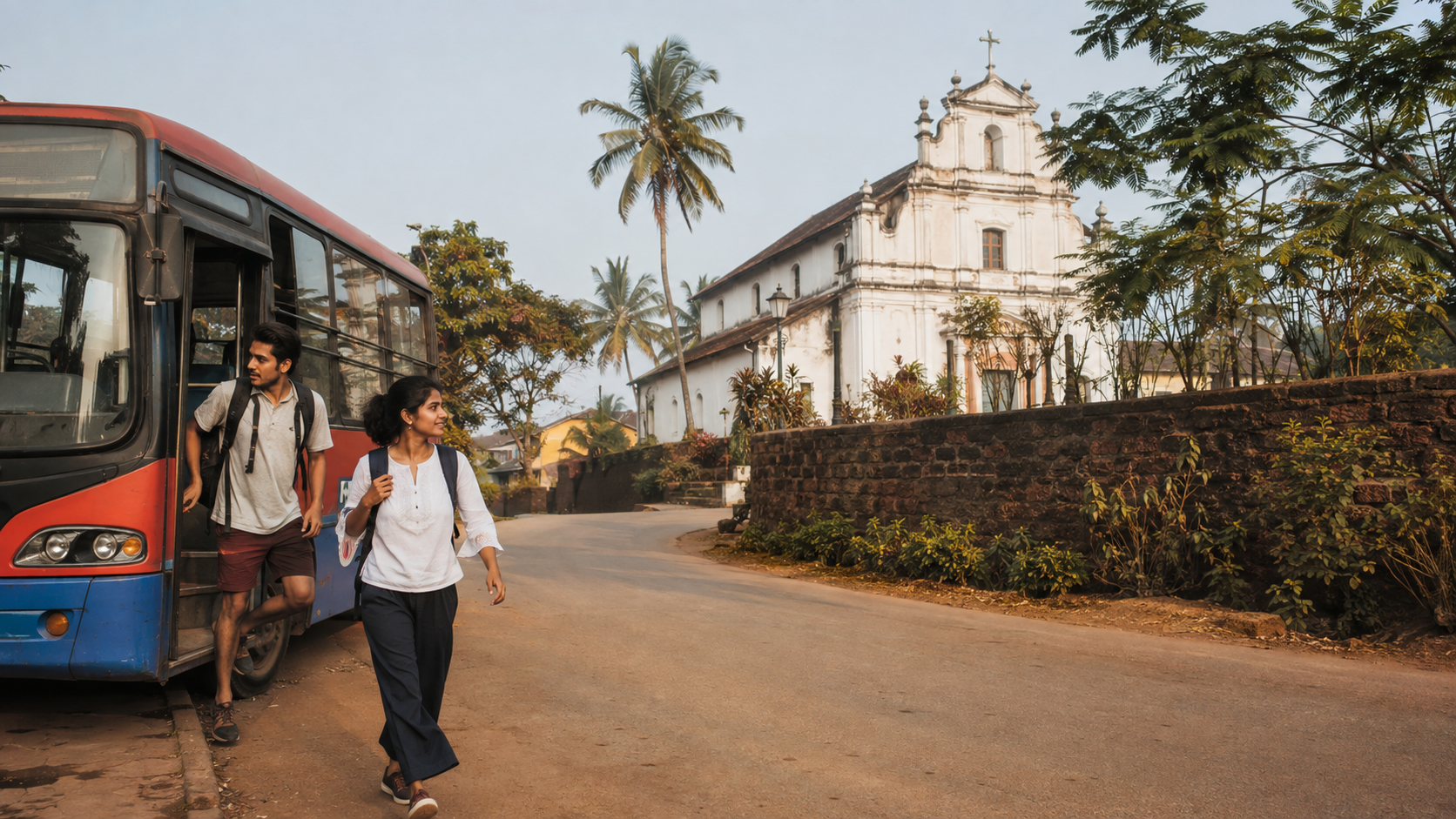
Take an early Kadamba bus from Margao to Panaji, store luggage only at a verified facility or your hotel, then continue towards the public ferry connection for Divar. The ferry is part of local transport, not a sightseeing ride. On the island, choose one village area—such as São Mathias/Malar—rather than trying to cross the whole island on foot. Roads can be sunny and buses limited, so ask locally for the next return service before wandering away from the jetty.
If your return train departs Madgaon, allow a generous buffer for the Panaji–Margao bus and station transfer. If the train departs Karmali, verify the connection separately; “nearby on the map” does not guarantee an easy public-bus link.
Where to stay when you do not have a car
Margao usually wins for rail access, affordable food and inland South Goa buses. Panaji works better for the central bus network, riverfront and ferry-side plan, but rooms can cost more. A remote resort may advertise a low nightly rate and still be expensive if the gate is kilometres from a reliable bus.
Before booking a hotel, open a map and measure the walking route—not the straight-line distance—to the bus stand. Read recent reviews specifically for road noise, cleanliness, hot water and late check-in. Call through the official number shown on the property’s verified listing. Never transfer money to a fresh WhatsApp number merely because the caller knows your booking dates. Ask for a written confirmation showing property name, room type, dates, cancellation terms and total amount.
A realistic budget for two adults, 3 nights and 4 days
The following is a planning range, not a fare quote. Train prices, room rates and holiday surcharges change.
- Return train: budget for two Sleeper or 3AC return tickets after checking the live IRCTC fare.
- Room: ₹1,200–₹2,500 per night for a simple, clean double room near a transport hub; three nights roughly ₹3,600–₹7,500.
- Local transport: keep ₹800–₹1,500 total for Kadamba/local buses, ferries where charged, station transfers and one backup shared ride.
- Food and water: ₹1,600–₹3,000 for two if you use local restaurants and avoid resort pricing.
- Admissions and contingency: ₹1,000–₹2,000. Pay an entry fee only at an official counter and ask for a ticket.
Add the live train fare to roughly ₹7,000–₹14,000 for two people on the ground. Public transport saves most when your hotel is well located and you return before sparse evening services.
How to speak with Konkani- and Marathi-speaking locals
Konkani is Goa’s official language, and you will also hear Marathi, Hindi and English. Do not assume every Goan is Marathi-speaking, and do not imitate an accent. Begin with a greeting, then ask, “Hindi or English okay?” Show the destination written on your phone, but confirm it aloud with the conductor. Use “please,” “thank you,” and “bus stand” rather than demanding an exact drop at a tourist spot.
Ask permission before photographing people, homes, fishing work or religious ceremonies. Stand in the queue, offer exact change where possible, and let passengers get off before boarding. These small habits solve more travel problems than memorising phrases you may pronounce incorrectly.
Beer, alcohol and the item visitors often confuse
Goa is associated with alcohol, but there is no single dependable “Goa beer price.” Retail MRP varies by brand and pack; bars, casinos, resorts and beach venues can charge much more. Read the printed MRP on sealed retail products and ask for the menu price, taxes and any service charge before ordering. Buy only from a licensed shop or venue. Do not accept an opened drink from a stranger, and check current rules before carrying alcohol across a state border.
Never drink and drive. This plan avoids driving, but alcohol can still make road crossings, ferries, platforms and water unsafe. Do not enter the sea after drinking. If someone in your group rents a vehicle, the designated driver should consume no alcohol.
Visitors sometimes say “almonds” when they mean Goa’s famous cashews. Prices vary by size, grade, flavour and whether the nuts are whole or broken. Compare the price per 500 g or kilogram, check the sealed pack, ingredient list, packing date and food-business label, and take a bill. A plain pack from a reputable shop may be better value than an unlabelled “premium local” bag offered by a tout.
Church visits without treating them as props
A church is an active place of worship, not merely a free attraction. Check opening times locally, avoid interrupting Mass, keep voices low and follow photography signs. Do not climb onto altars, graves or heritage structures. For a quieter trip, use village churches in Chandor, Rachol or Divar as anchors for learning about the settlement; do not promise yourself that every interior will be open.
Casino and fake-offer checklist
Casinos can destroy a budget faster than taxis. If you still choose to enter, verify the operator through its official website and official counter, check age and ID requirements, entry inclusions, dress code and final price before paying. Government records distinguish authorised operators; a street promoter, taxi driver or WhatsApp account is not proof of legality.
- Ignore “guaranteed win,” “free chips with cash-back” and secret-table claims.
- Do not send UPI money to a personal name for an entry voucher.
- Never hand your original ID, bank card or phone to a tout.
- Set a small entertainment limit before entering; do not borrow or chase a loss.
- Use the venue’s official transport desk or a verified service for the return.
Small things to carry that prevent expensive problems
- Government ID, train ticket saved offline and hotel confirmation.
- Power bank, charging cable and screenshots of the day’s route.
- Refillable water bottle, cap, sunscreen and light rain cover.
- Small cash and coins for buses, separated from your main wallet.
- Modest clothing or a light layer for churches.
- Basic medicines you already use; avoid buying unknown remedies from touts.
FAQs
What is the cheapest sensible way from Surat to Goa?
A confirmed Sleeper-class train to Madgaon, followed by Kadamba/local buses, is usually the strongest combination of low cost and usable travel time. Check live fares and running days before deciding.
Can I complete this trip with no taxi at all?
Possibly, but do not make “zero taxi” a rigid target. A delayed train, late arrival or missed village bus may require a verified backup ride. Save money through planning, not by taking an unsafe walk at night.
Is Madgaon or Panaji the better base?
Choose Madgaon for the railway and quieter southern/inland routes; choose Panaji for central buses and the Divar ferry plan. For four days, one base is cheapest. Split only if your return station makes it worthwhile.
Are public buses reliable for hidden places?
Main corridors are easier than village connections. KTCL publishes operated routes, but exact times and local stopping patterns can change. Ask at the bus stand each morning and confirm the final return.
Should I book a cheap remote resort?
Only if it offers a genuine shuttle or is on a frequent bus route. Otherwise the room saving can be smaller than the taxi cost. A plain hotel near Margao or Panaji bus stand is often the better car-free choice.
How do I avoid fake hotel, casino or tour offers?
Book through the property or operator’s verified channel, insist on written terms and a receipt, and avoid personal UPI requests, urgency messages and strangers offering tickets. Goa Tourism advises visitors to use registered tourism services and authorised counters.
Can I carry alcohol back to Gujarat?
Do not assume that a Goa purchase can legally travel across state borders. Gujarat has strict alcohol laws. Check current rules with the relevant authorities before carrying any alcohol; the safest budget choice is not to transport it.
When should I avoid this public-transport plan?
Avoid tight village circuits during severe rain warnings, very late arrivals, major holiday crowding or when a traveller cannot manage heat and walking. Shorten the route and keep a larger buffer rather than forcing every stop.
Practical note: Train schedules, bus operations, entry conditions and prices change. Reconfirm trains through IRCTC/NTES, local routes with KTCL or the bus-stand controller, and tourism businesses through their official channels shortly before travel.
Leave a Reply