
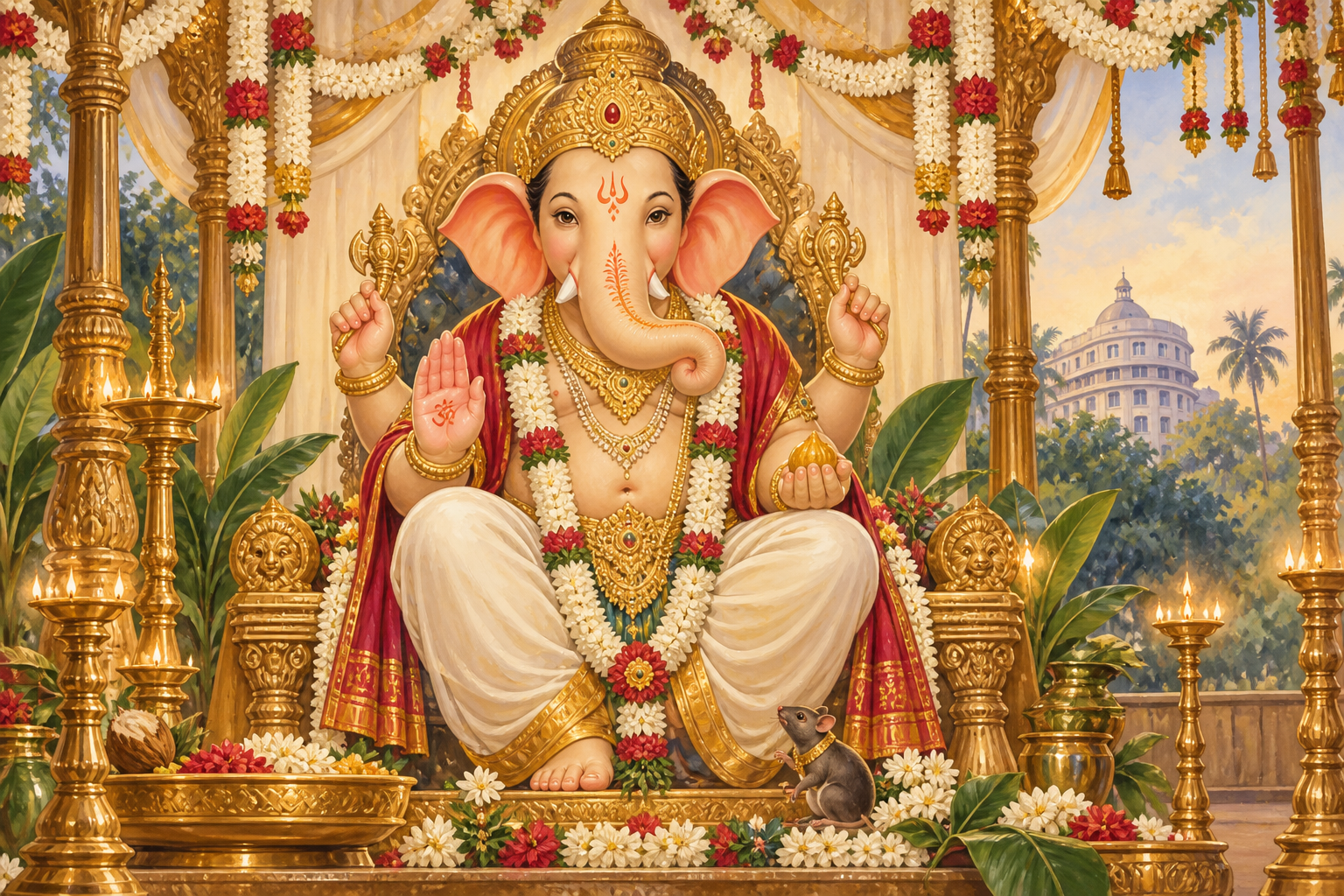
Featured image: AI-generated illustration inspired by Ganeshotsav; not a photograph of the 2026 GSB idol or venue. Information checked 14 September 2026.
Visiting Mumbai’s celebrated “gold Ganpati” needs more planning than finding a glittering photograph online. At GSB Seva Mandal in King’s Circle, the attraction is also the worship: lamps, offerings, volunteers and families returning for their annual darshan. This 2026 guide separates confirmed festival information from practical estimates, helping you choose the right station, understand seva bookings and avoid confusing insurance headlines with the value of the idol.
First, choose the right GSB celebration
This guide covers GSB Seva Mandal, King’s Circle, Mumbai. It is different from the GSB Sarvajanik Ganeshotsava Samiti celebration at Wadala’s Ram Mandir. Check the organiser’s name before booking a seva or sharing a taxi destination; searching only “GSB Ganpati” can lead to the wrong celebration.
The official venue is Shree Sukriteendra Nagar, A. Rama Nayak Hall and G.S.B.S. Sports Club Ground, near S.N.D.T. Women’s College, R.A. Kidwai Road, King’s Circle, Mumbai 400019. The administrative office behind Sion Fort is not the festival entrance. Save the venue address before leaving your hotel.
2026 dates and a useful planning table
| Question | Visitor information |
|---|---|
| Festival dates | 14–18 September 2026; the 72nd celebration. |
| Opening ritual | Prana Pratishtha: 14 September, 7:00 am. |
| Visarjan day | 18 September; follow the organiser’s final instructions. |
| Overnight access | The official appeal says the main gate closes from 11:00 pm to 6:00 am. |
| Nearest practical rail options | Matunga on the Central line; King’s Circle on the Harbour line. |
Use the official 2026 programme for ritual timings. A programme time is not a guaranteed queue clearance time. Leave a generous buffer if your darshan must fit between a train arrival and an onward journey.
Insurance: what does ₹703.27 crore mean?
Free Press Journal’s September 2026 report puts this year’s insurance cover at ₹703.27 crore, covering several categories including the pandal, jewellery, volunteers and devotees. This is the reported insurance cover, not the premium paid. It should not be described as the cash value of the Ganesh idol.
The same report describes more than 66 kilograms of gold ornaments and over 335 kilograms of silver. These are reported ornament quantities, not an independently audited valuation by MadeForTrips. The report says devotees donate ornaments, which are retained for adornment rather than auctioned. Jewellery totals reported elsewhere may differ.
Calling this a “gold and silver investment” would therefore mislead travellers. This is devotional adornment, not an investment product visitors can buy. Insurance also does not replace ordinary precautions: keep your phone secure and do not assume every personal loss automatically qualifies for compensation.
Why this pandal matters beyond its jewellery
The mandal’s official appeal traces the trust to 1951 and its Ganesh festival to 1955. Its connection with Shri Kashi Math, Varanasi, and traditional Vedic worship helps explain why the ritual programme matters as much as the decoration. Volunteer service is central to the celebration.
For a first visit, watch how the space works rather than rushing to capture everything. Notice the movement between worship, offerings and distribution areas. Keep the queue moving when your turn arrives. A brief, attentive darshan can be more satisfying than spending the entire visit trying to obtain an unobstructed photograph.
How to reach King’s Circle without unnecessary detours
Matunga station on the Central railway line and King’s Circle station on the Harbour line are useful arrival choices. Matunga Road is a different station on the Western line. Check the complete station name when buying a ticket or following a map, particularly if you are unfamiliar with Mumbai’s suburban network.
From either suitable station, allow roughly 15–25 minutes for walking, crossings and locating the active entrance. This is a planning allowance, not a measured walking time or queue estimate. Festival diversions can make the final approach longer. Ask volunteers which entrance serves ordinary darshan before joining a line.
Western line passengers can consider changing at Dadar for the Central line, checking the platform and destination boards before boarding. Harbour services have different routes, so confirm that your chosen train stops at King’s Circle. Do not assume every Harbour train serves it.
For taxis, show the full festival address and accept that a drop point may be outside the immediate venue. Avoid making a tight return booking from the pandal gate. Families should agree on a meeting point away from the busiest entrance before entering the crowd.
Darshan, fees and paid sevas
Ordinary darshan and a booked ritual are different arrangements. Do not treat a paid seva as an unlimited VIP access pass. Ask the official help desk about the current ordinary queue, accessibility support and any entry conditions; never pay an unofficial agent promising guaranteed fast entry.
The official seva booking portal lists the following examples. Availability and the amount shown at checkout should be checked before payment.
| Seva | Listed amount |
|---|---|
| Ganahoma | ₹705 |
| Modak Naivedya | ₹625 |
| Durva Archana | ₹575 |
| Prasad Vitarana | ₹555 |
Save your receipt and QR code on your phone before travelling. Read the selected seva’s participation instructions instead of assuming that booking payment settles every entry requirement. Check which date you selected, how many people may enter and where to report. Keep a screenshot available in case mobile connectivity becomes unreliable.
Donations: use the organiser’s own channel
Start from the official donation page or the authorised counter. Confirm the recipient, amount and purpose, then retain the acknowledgement. Avoid copying bank details from forwarded messages, screenshots or unofficial social accounts. An impressive logo alone does not establish that a payment request is genuine.
If you want to donate jewellery, materials or volunteer time, contact the mandal before carrying anything valuable to the venue. Ask what is accepted and how it will be documented. Thoughtful service can be useful without involving a large donation; never let crowd pressure dictate your contribution.
Muhurat and visarjan: two different schedules
Drik Panchang’s Mumbai calendar gives the Ganesh Chaturthi Madhyahna puja window on 14 September 2026 as 11:20 am–1:48 pm IST. That is a city calendar reference, not the mandal’s installation time or a booked darshan appointment. Follow the organiser’s programme for worship at this venue.
The mandal’s five day celebration ends on 18 September, earlier than Mumbai’s main Anant Chaturdashi immersions. Its programme lists the procession starting at 10:00 pm towards Girgaon Chowpatty. Departure is not immersion time: traffic controls, crowds and ceremonial progress affect the journey. Confirm updates before travelling specifically to watch.
Safety, clothing and practical comfort
The official appeal prohibits outside coconuts, sweets, flowers and prasad for security reasons. It also specifies dress restrictions for visitors above twelve, including shorts and short T-shirts. Check its detailed instructions for your booked ritual before packing.
Carry a small bag, comfortable footwear and only necessary valuables. Plan medication, drinking water access and toilet stops before joining a long queue. Do not rely on a fixed waiting time quoted by another visitor; conditions can change within minutes.
Keep children beside an adult and give them a written contact number. Anyone feeling faint should alert a volunteer immediately. Avoid stopping on stairs or pushing against a moving crowd. Photography should follow staff instructions, and strangers deserve privacy during worship.
Nearby pandals and a realistic Mumbai itinerary
Wadala’s GSB celebration is a separate possible stop, not another entrance to this mandal. Lalbaugcha Raja, Ganesh Galli and Chinchpoklicha Chintamani form another popular festival circuit, requiring additional travel and separate queues. Our Lalbaugcha Raja guide helps you plan that visit.
Choose one major darshan as your priority. Add a Matunga meal break or another pandal only if everyone has energy. Save distant sightseeing for another day; rushing between famous locations rarely improves a crowded festival visit.
A plan for families
Before departure, put your station choice, venue address, return route and booking receipt together in one saved note. Share it with another adult in your group. Decide whether the priority is ordinary darshan, participation in a specific seva or observing the procession; trying to combine all three can turn a manageable outing into an exhausting day.
At the station, pause before walking into the crowd. Check that everyone has arrived, use available facilities and identify the direction of the venue. At the pandal, ask a volunteer about the correct queue and current restrictions. If the wait is unsuitable for an older relative or young child, reconsider the visit before committing to a long line.
For the return journey, choose a meeting point that does not block an exit. Keep enough phone battery for navigation and tickets. A portable charger can help, provided it complies with current entry rules. Carry a little cash for incidental transport without displaying valuables.
Lastly, allow the day to remain flexible. A meaningful festival visit does not require seeing every famous pandal or taking a perfect photograph. Arriving at the correct place, respecting worshippers and returning comfortably are better measures of a successful outing for everyone travelling together.
Book travel through official websites
Use IRCTC for reserved Indian train tickets, IRCTC Tourism for packages and MSRTC for Maharashtra bus information. Confirm dates, boarding points and cancellation terms directly. MadeForTrips is an independent guide, not the mandal or a booking agent.
Leave a Reply