
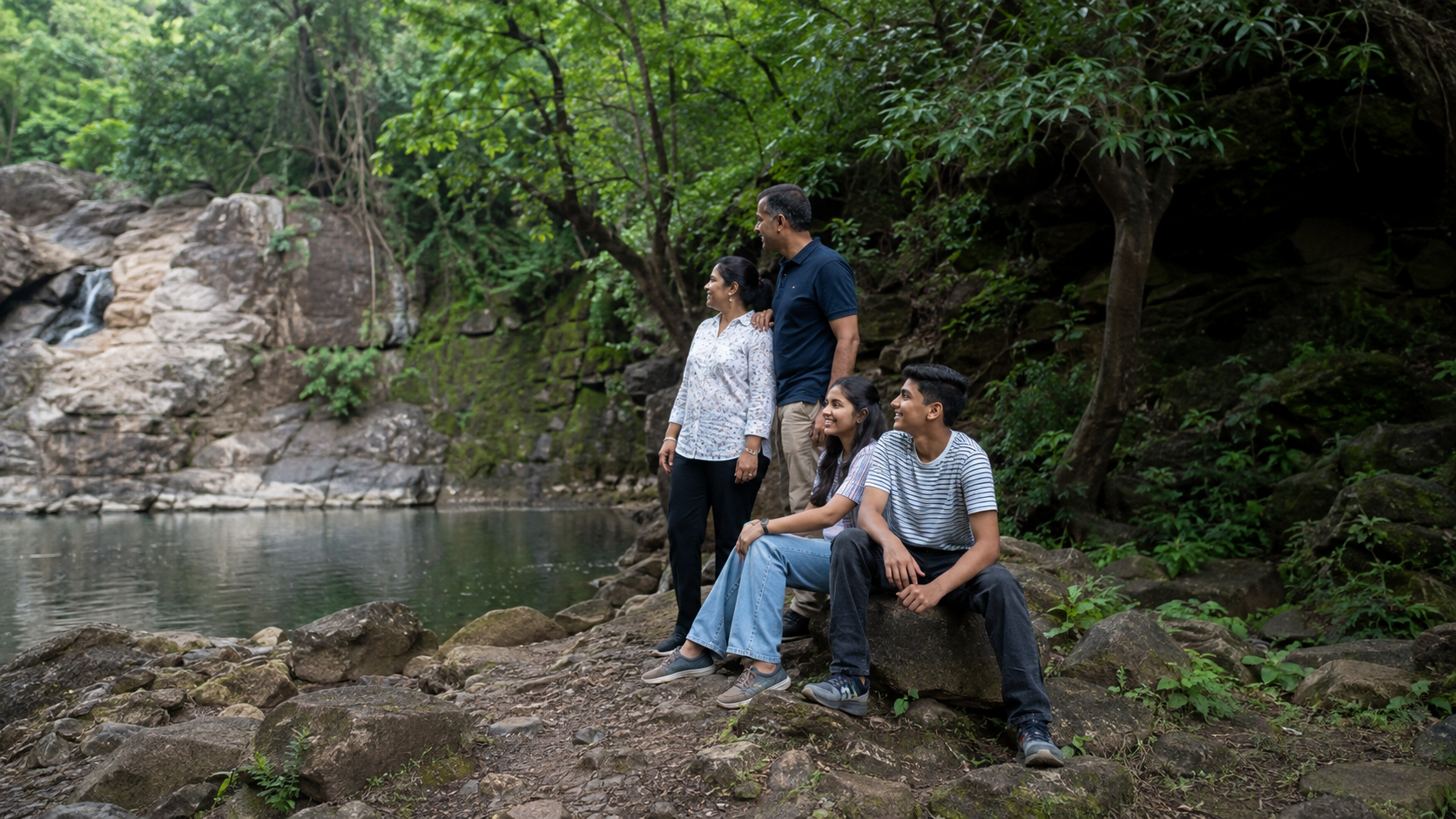
Can I comfortably visit Anjani Kund and Anjani Cave with children and family? The honest answer depends on which part of the place you mean. A family visit to the village-side shrine and kund can be a calm, manageable outing for many age groups. Reaching the cave, waterfall or upper forest sections is a different plan: it may involve an unpaved trail, uneven ground, stream crossings or slippery slopes, especially during and soon after the monsoon.
This distinction matters. Online photos often combine the temple, kund, cave, waterfall and green hills as though they are one easy roadside attraction. They are not necessarily equally accessible. Families should decide before leaving whether they want a devotional stop near the settlement or an outdoor trek. Do not pressure toddlers, elderly relatives or anyone with joint, balance or heart concerns to complete the harder route.
First decision: shrine visit or forest trek?
Plan A: Anjani Mata shrine and kund
This is the more realistic family choice. Anjani village lies in the forested Dang region, south of Ahwa. The site is associated with a local religious belief that Anjani Mata performed penance here and that Hanuman was born in a nearby cave. Treat this as a living local tradition rather than a historically proven claim. Dress respectfully, keep voices low and remember that the kund is sacred to devotees—not a swimming pool or picnic pond.
A short shrine-focused visit may suit schoolchildren, grandparents who can manage basic village surfaces, and parents carrying a baby. Conditions can still change: parking may be informal, the final approach may be narrow, and steps or rough patches can exist. Ask a local person where the safe visitor route ends before walking towards the hills.
Plan B: cave, waterfall and upper trail
Choose this only for physically capable family members. Reports differ on the exact trail length and time because visitors use different starting points and turn around at different places. Some describe a short 20–30 minute walk; others report roughly an hour or several kilometres for the wider route. That uncertainty is itself useful information: arrive early, obtain current local guidance and do not assume that a map pin represents an easy finished path.
The cave route is better considered a rural forest walk than a developed tourist walkway. Rain can make rock, mud and leaf-covered ground slippery. Water flow can alter crossings. A child who is comfortable in a city park may still struggle here. Families should never enter an unfamiliar cave, deep water or isolated forest section merely to reproduce a photograph.
Who is likely to enjoy Anjani?
Toddlers and preschoolers: Keep the plan to the temple, kund and a brief village-side visit. A stroller may not work well on broken or muddy ground. A child carrier is more practical, but the adult must remain stable and avoid steep sections. Keep children continuously within arm’s reach near water.
Children aged 6–11: Curious children may enjoy the forest setting and the Hanuman tradition. The shrine plan is suitable if they can follow instructions. Consider the trail only if current conditions are dry, a reliable local guide confirms it is manageable, and the child already handles uneven walks without becoming exhausted.
Teenagers: Fit teenagers may enjoy the longer route, but enthusiasm is not the same as judgment. Set a turnaround time, keep the group together and stop if rain, fading light or rising water changes conditions.
Senior citizens: A vehicle-supported shrine visit can be meaningful, subject to the actual last-mile surface. The cave trek is generally a poor choice for people with knee pain, limited balance, breathlessness or recent surgery. One family member should stay with seniors rather than leaving them alone near a parked vehicle.
A realistic comfort and facilities check
Anjani should not be planned like a polished resort attraction. Older visitor information has reported limited or absent food, toilets, drinking water and formal accommodation at the site. Development may change, but families should verify current facilities through a local contact or tourism office shortly before travel. Carrying your own essentials is safer than expecting shops to be open.
- Toilets: Do not assume clean, continuously open toilets are available at the trail or cave. Use verified facilities in Ahwa or another main stop before the last stretch.
- Food: Carry a simple meal and sealed snacks. Do not leave wrappers or food waste in the forest.
- Drinking water: Each person needs sufficient safe water. Natural water may look clean but should not be treated as potable.
- Shade and seating: Trees provide some natural shade, but formal benches or rain shelters cannot be relied upon. Carry a compact ground sheet if appropriate and rest only in a safe open place.
- Mobile network: Coverage in hilly forest areas can be intermittent. Download maps beforehand and share your plan before leaving the main road.
- Medical help: Carry personal medicines and basic first aid. Ahwa is the practical town to identify for medical assistance before the trip; confirm the nearest currently operating clinic or hospital locally rather than depending on an old online listing.
Road, rail and air: what actually makes sense?
From Surat: A private car or hired cab is normally the simplest family option because the destination requires a last-mile road journey. The route generally runs towards Vansda/Waghai or Ahwa, depending on current road advice. Allow most of a day for travel plus the visit, and avoid beginning the return after dark. Public buses may help reach Ahwa, but onward frequency and the final connection must be checked locally.
From Vadodara: Road travel is the practical door-to-door choice, but it is a long outing. An overnight base in Ahwa, Saputara or another suitable town makes more sense than forcing a same-day return with children. If travelling by train, use a station that fits your wider Dang itinerary and arrange a confirmed cab for the remaining road sector; there is no direct rail arrival at Anjani Kund.
From Ahmedabad: Treat this as an overnight or two-day trip. Driving the entire distance is possible for experienced drivers, but sharing driving or hiring a cab reduces fatigue. Rail can shorten part of the journey only when paired with a pre-arranged road transfer. Flying usually offers little practical advantage for this specific trip after airport time and the remaining long road journey are counted.
Distances shown by mapping services vary with the selected Anjani pin and route. Check a live map on departure day, confirm the final road with your host or driver, and keep extra fuel. In the last section, a slightly longer known road is preferable to an unverified shortcut.
Best months for a family visit
October to February usually offers the most comfortable balance for families: cooler weather, greener surroundings after the rains and a lower chance of intense monsoon flow. The exact trail can still remain damp in early October.
Monsoon makes the hills and waterfall more dramatic, but also creates the greatest risk from slippery rock, mud, sudden rain, poor visibility and changing water levels. Families with small children or seniors should normally avoid the cave/waterfall trek in heavy rain.
March to May can be hot and tiring, and the kund or seasonal water features may have less water. If visiting, use an early morning window and carry more drinking water. Festival days may offer cultural interest but can bring crowds and difficult parking; confirm the date and local arrangements.
How long should a family allow?
Allow about two to three hours for a relaxed shrine-and-kund visit including pauses, not counting the road journey. For the cave or waterfall route, reserve at least half a day and start early enough to return well before sunset. From Surat, a long day trip may work for the easier plan. From Vadodara or Ahmedabad, an overnight stay is the more comfortable decision.
Approximate family budget
For two adults and two children travelling from Surat by private car, a sensible planning range is ₹3,500–₹7,500 for a day trip. This assumes roughly ₹2,000–₹4,000 for fuel/tolls or a larger amount for a hired vehicle, ₹1,000–₹2,000 for meals and water, and a contingency for parking, a local guide or unexpected route changes. An overnight stay can add approximately ₹2,000–₹6,000 depending on room standard and season.
This is a planning estimate, not a quoted package. We could not verify a dependable current entry, parking or guide fee for every part of the site. Ask locally before accepting any paid service, agree on the price and route in advance, and request a ticket where an official charge applies.
Two-part family packing checklist
For every visitor
- Refillable drinking-water bottles and oral rehydration sachets
- Simple packed food, fruit and sealed snacks
- Sun hats, sunscreen and a light rain layer
- Personal medicines, bandages and antiseptic wipes
- Cash in small notes, charged phones and an offline map
- Waste bag so everything carried in is carried out
- Modest clothing suitable for a religious site
Only if attempting the trail
- Shoes with reliable wet-grip soles—not smooth sandals
- Insect repellent and full-length, breathable clothing
- A small torch for emergencies, not for unsupported cave exploration
- Walking support if normally used, while recognising it cannot make a steep route safe
- A waterproof pouch for medicines and electronics
- A locally confirmed guide or knowledgeable adult leading the group
When I would avoid taking children here
I would postpone the cave or waterfall plan during heavy rain, thunderstorms, very high water, extreme heat or when local residents advise against the trail. I would also avoid it if arrival is late, the family lacks proper footwear, the route is deserted, or no one can confidently identify the return path.
For toddlers, I would avoid any section beside fast water, exposed rock or a drop without a secure barrier. For older children, I would cancel rather than let a fixed itinerary overrule tiredness, fear or changing weather. The shrine visit can still be worthwhile even when the trek is not.
Parent-focused FAQs
Is Anjani Kund a place for swimming?
No. It is regarded as sacred, and water conditions are not controlled like a swimming pool. Keep children out of the kund and follow local religious guidance.
Can we take a stroller?
A stroller may help only on a firm village-side surface. It is unsuitable for a rough forest trail. A carrier may be more useful for the easy section, provided the adult is steady.
Is the cave beside the road?
Do not assume so. Visitor accounts describe walking through the surrounding terrain, and reported times vary. Ask locally about the present starting point and route.
Do we need a guide?
For a simple shrine stop, probably not. For the cave or waterfall trail, local guidance is strongly sensible because paths and seasonal conditions can change.
Are food and toilets guaranteed?
No. Carry food and water, and use a verified toilet before the final rural stretch. Reconfirm any recently added facilities before travel.
Can senior citizens visit?
Many seniors may manage the shrine portion if the last-mile surface suits them. The upper trek should be skipped when there are mobility, balance, breathing or cardiac concerns.
What is the most family-friendly plan?
Arrive in the morning, visit the shrine and kund respectfully, assess conditions with a local person, enjoy a packed meal in an appropriate area and return before evening. Treat the forest trek as an optional separate activity, not an obligation.
Practical note: Rural roads, water flow, access rules and facilities can change. Reconfirm conditions with local authorities or residents shortly before departure and obey barriers and on-site instructions.
Nearby Places You May Also Like
Continue planning your South Gujarat trip with these nearby family-focused guides:
Leave a Reply