
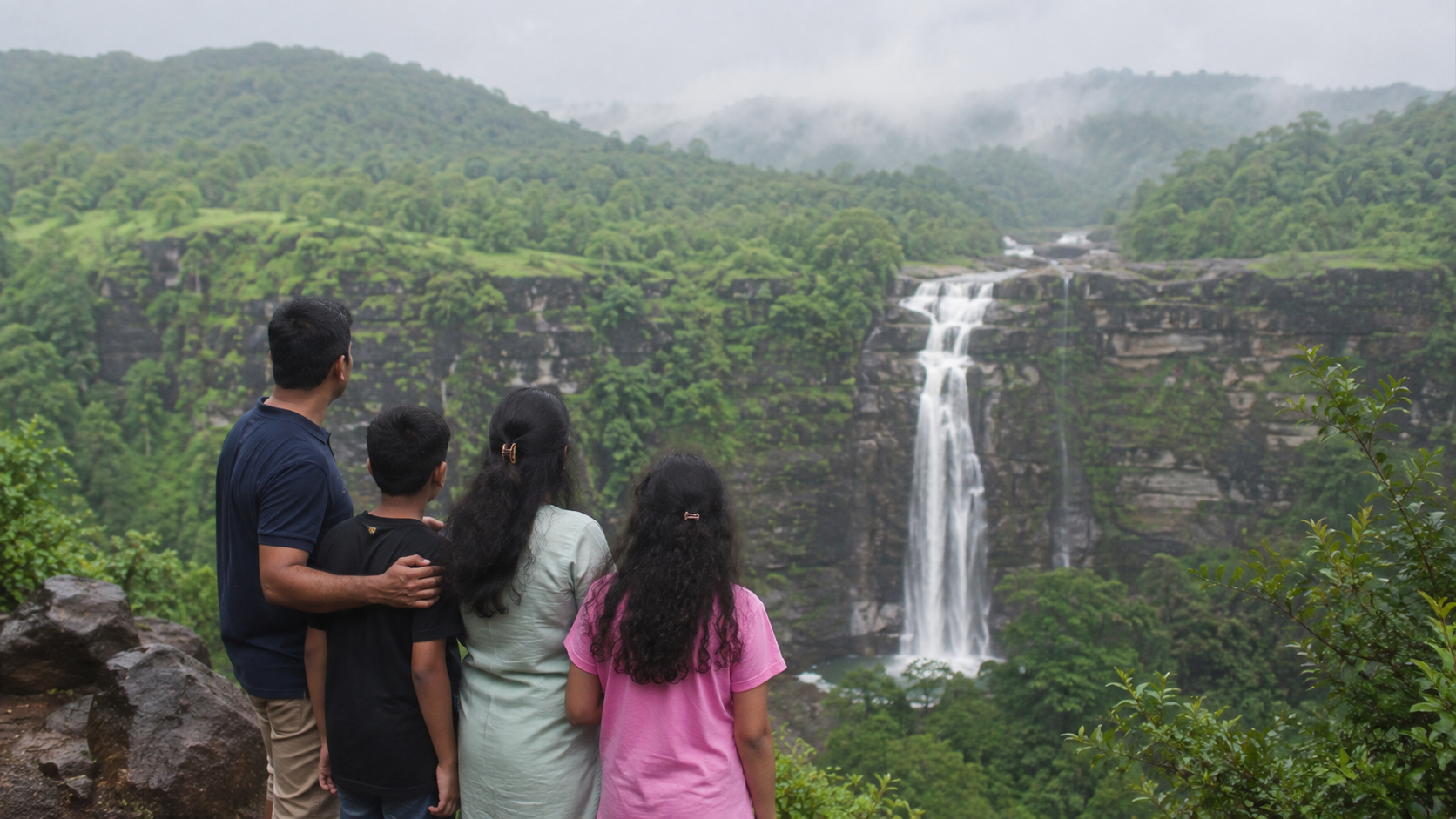
Can I comfortably visit Chimer Waterfall with children and family? For most families, the answer is “only if everyone is ready for a remote rural walk.” Chimer is not a developed roadside waterfall. Available reports place it near Chimer village in Songadh taluka of Tapi district, with the final approach passing through fields, forest or uneven paths. The exact route, distance and condition change with season, so this trip requires more caution than a conventional viewpoint.
Chimer is also called Chichkund in some local and travel references. Claims about its exact height vary widely and are often described as unofficial. That debate does not help parents. What matters is that it is a high seasonal cascade with steep terrain, strong monsoon water and limited services. See it from a safe natural viewpoint; do not plan to reach the pool or stand under the fall.
Start with one honest question: can the whole family walk back?
Visitors often focus on the excitement of reaching a waterfall and forget that every downhill step must be reversed. A reported one-to-two-kilometre approach can feel much longer in mud, humidity or rain. The route may cross farmland and small streams, and it may not have uniform signs, railings or paving. Before starting, ask a local resident about today’s safest viewing point, recent rainfall and the time needed for a round trip.
If any family member is uncertain, choose a short village-side nature stop instead. Splitting the group is acceptable only when a responsible adult stays with those who do not trek and everyone agrees on a meeting time.
Age-by-age recommendation
Babies and toddlers: I would generally avoid the waterfall trail. A carrier does not protect the carrying adult from slipping, and changing or feeding facilities are unlikely near the path. A brief drive to the area is different from attempting the full approach.
Children aged 6–9: Consider the walk only in stable post-monsoon weather, with local guidance and children who already manage uneven trails. They must reliably stop when told and stay away from water and drops.
Children aged 10–13: Fit children may enjoy the forest walk, but pace it for the slowest person. Give each child water, insist on grippy shoes and set a turnaround time.
Teenagers: This can be an engaging outdoor day, provided photo-taking never overrides barriers or footing. No scrambling toward the base, cliff edge or wet rock.
Senior citizens: The full route is usually unsuitable for anyone with knee pain, poor balance, breathlessness or cardiac concerns. Even active seniors should decide after seeing the actual surface, not from online pictures.
Why monsoon beauty creates extra risk
Chimer depends heavily on rain. The same rain that creates the waterfall can turn soil into mud, hide loose stones, increase stream current and reduce road visibility. Water may rise after rainfall upstream even when it is not raining at the viewpoint. Leeches, mosquitoes and other insects are more active in wet vegetation.
Never enter a plunge pool or flowing channel. Depth and underwater rock are unknown, and a waterfall’s force creates currents that are difficult to judge. Do not use a drone or selfie stick where it distracts you from footing or other visitors.
Facilities reality check
Plan Chimer as a low-facility destination. Current dependable information about toilets, staffed entry points, drinking water, restaurants, seating and regular medical help at the waterfall is limited. Take this uncertainty seriously.
- Toilets: Use a verified facility in Songadh, Vyara, Ahwa or your accommodation before the rural section. Carry tissues and sanitiser.
- Food: Bring a packed meal and snacks. Do not depend on a stall being open.
- Vegetarian and Jain needs: Pack suitable food or arrange it with a known restaurant. Confirm onion, garlic and preparation requirements clearly.
- Non-vegetarian food: Do not expect reliable availability near the trail; plan a meal in a larger town.
- Drinking water: Carry enough safe water for the walk and return. Stream water should not be consumed untreated.
- Shade and rest: Forest shade exists, but benches and shelters may not. Rest on stable ground without blocking village paths or damaging crops.
- Mobile service: Treat network coverage as uncertain. Save maps offline and share your return time.
Respecting the village and forest
The approach may pass through land used by local families. A walking line on a map is not permission to enter a field, open a gate or park across an access road. Ask politely, use the route residents indicate, and pay an agreed amount if you hire a local guide. Do not photograph people or homes without consent.
Carry out every bottle, wrapper and tissue. Avoid loud music. Do not pick plants, feed wildlife or light a fire. Responsible behaviour protects both the landscape and continued visitor access.
Travel from Surat, Vadodara and Ahmedabad
From Surat
Road is the most practical option. Drive towards Vyara/Songadh, then use a currently confirmed rural route to Chimer village. Published estimates commonly place the village around 35–40 kilometres from Songadh, but map pins and roads differ. A private car or hired cab with a driver comfortable on narrow wet roads is preferable to relying on an unconfirmed last-mile bus.
Rail can make sense only as far as Vyara or another suitable station, followed by a pre-arranged road vehicle. Flying does not make practical sense from Surat itself.
From Vadodara
Use Songadh or Vyara as a route base, or combine the trip with an overnight stay in south Gujarat. A same-day return plus trek can exhaust children. Train travel to a convenient south Gujarat station is possible, but a reliable cab is still required for the last sector.
From Ahmedabad
Plan at least one overnight stay. Driving all the way, trekking and returning the same day is not a comfortable family plan. Rail to Surat or Vyara may reduce some driving, though transfers add time. Air travel to Surat is useful only for travellers arriving from farther cities; it does not remove the long road journey to Chimer.
Fill fuel in a main town, check tyres and brakes, download the map and avoid unknown shortcuts. Leave the waterfall area early enough to complete the rural road in daylight.
Best months: choose trail conditions, not maximum drama
July to September usually gives the most powerful flow, but this is also the hardest period for family walking. Heavy rain can make the route unsuitable. October and November may be a better compromise: greenery and water often remain while some paths begin to dry. Conditions vary each year.
Winter can offer easier walking but reduced flow. Summer may leave little or no waterfall and exposes visitors to heat. Obtain a recent local update before travelling; an old monsoon video cannot confirm today’s water or access.
Recommended duration and day design
Reserve half a day from Songadh or another nearby base. Start after an early breakfast, reach the village in the morning, confirm the route, and allow two to four hours for a cautious walk with rests. Begin returning before afternoon rain or fading light becomes a concern.
From Surat, the full outing is a long day. From Vadodara or Ahmedabad, stay overnight. Avoid combining Chimer with several distant attractions on the same day; children need rest, food and flexibility more than a long checklist.
Approximate family budget
For two adults and two school-age children travelling from Surat by private car, budget approximately ₹3,500–₹7,000. Assumptions: ₹2,000–₹4,000 for fuel, tolls and vehicle costs; ₹800–₹1,800 for packed food and a town meal; and ₹500–₹1,200 as contingency for parking, local guidance or route changes. A hired vehicle can raise the total.
An overnight room may add roughly ₹2,000–₹6,000 depending on town, season and weekend demand. We could not verify a current official entry or parking fee. Reconfirm locally, agree on guide charges before starting and ask for an official ticket where applicable.
Family packing checklist for Chimer
- Closed trekking shoes with wet grip; spare socks
- Light rain jackets and a waterproof bag
- At least adequate drinking water for the full return walk
- Packed meal, energy snacks and oral rehydration sachets
- Personal medicines and compact first aid
- Insect repellent and full-length breathable clothing
- Charged phones, power bank and offline map
- Small cash, ID and vehicle emergency supplies
- Dry clothes for children
- Waste bags
- A whistle for emergency group contact—not for casual noise
- A written turnaround time
Medical and emergency planning
Before leaving, identify a currently operating clinic or hospital in Songadh or Vyara and save its number. Do not describe a distant map listing as “nearby medical help.” If someone has a significant fall, breathing difficulty, allergic reaction or suspected fracture, seek professional assistance rather than attempting an unsupported trek onward.
Carry required prescriptions, allergy information and emergency contacts. With patchy network, prevention and an early return are especially important.
When I would avoid taking children here
I would cancel during heavy rain, a thunderstorm warning, high stream flow, poor visibility or any official restriction. I would also avoid the trek if no one can confirm the route, the group arrives late, footwear is unsuitable, or the child cannot follow safety instructions consistently.
I would not take toddlers to the gorge or base, and I would not take seniors with mobility limitations merely because the family has travelled a long distance. The correct decision can be to turn around.
Useful FAQs for parents
Is Chimer a roadside waterfall?
No. Reports describe a rural walk from the village, often estimated around one to two kilometres. Verify the present route locally.
Is Chimer Gujarat’s highest waterfall?
It is often described that way, but published heights conflict and some reports call the figures unofficial. Visit for the landscape, not a record claim.
Can we swim at the bottom?
No swimming should be part of a family plan. The pool, currents, falling water and rock conditions are uncontrolled.
Do we need a local guide?
Local guidance is strongly sensible when signs are unclear or the route crosses fields and forest. Agree on the route, duration and price first.
Can we take a stroller?
A stroller is not practical on muddy, uneven or narrow paths.
Are toilets and food available?
Do not depend on them. Use town facilities and carry food, water and hygiene supplies.
Which month is best with children?
October or early November can offer a better balance than peak rain, provided recent local information confirms water and safe access.
What makes this trip successful?
An early start, a small capable group, local route confirmation and willingness to turn back. Reaching the closest possible point is not the goal; returning comfortably is.
Access, water flow, paths and local services can change quickly. Verify conditions shortly before departure and follow instructions from residents, forest staff and local authorities.
Nearby Places You May Also Like
Continue planning your South Gujarat trip with these nearby family-focused guides:
Leave a Reply