
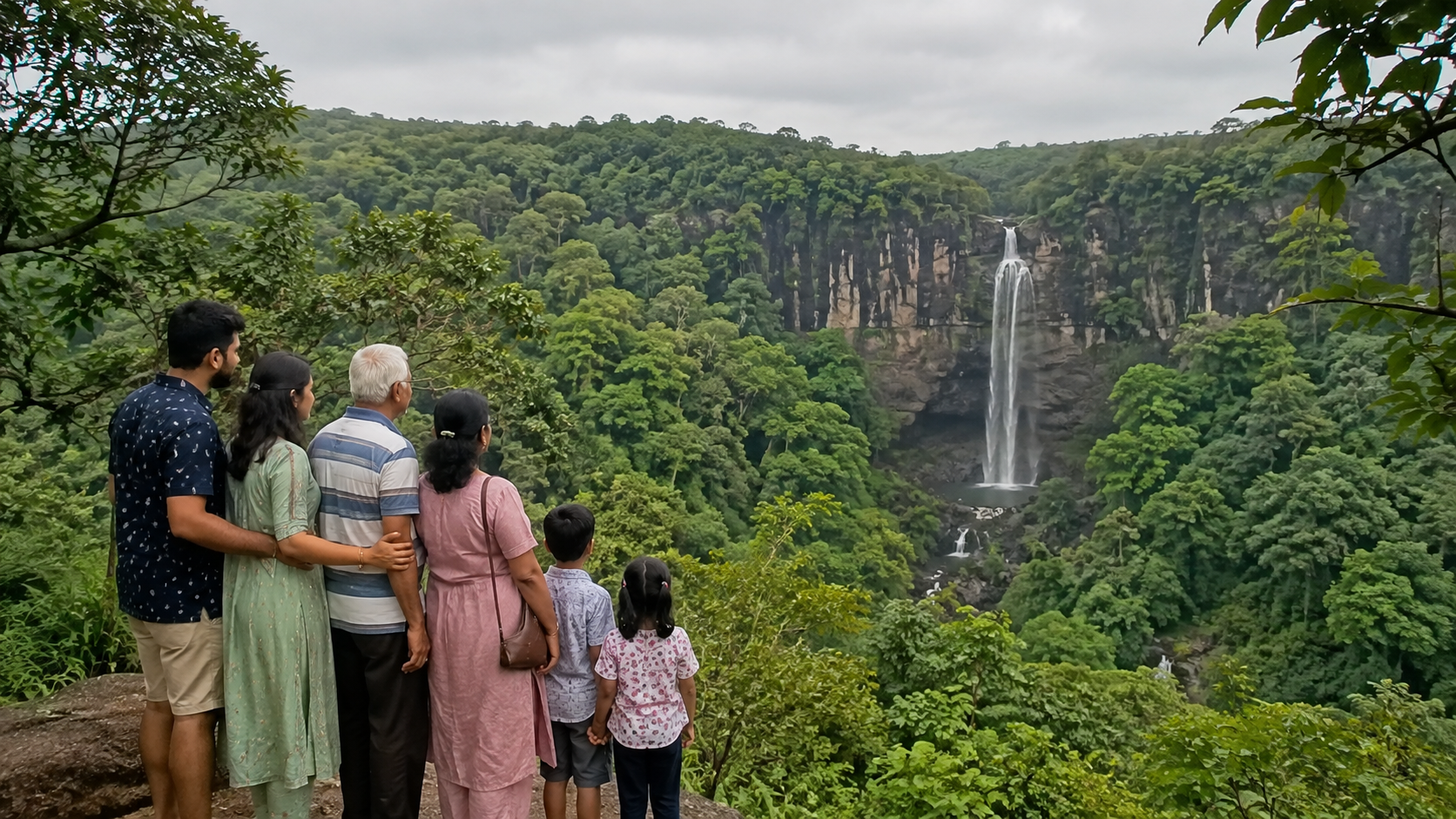
Can I comfortably visit Girmal Waterfall with children and family? Yes, if your family treats it as a scenic viewpoint in a remote forest landscape—not as a place to swim, climb wet rocks or stand close to the drop. Girmal is in the Subir side of Gujarat’s Dang district and is different from the better-known Gira Waterfall near Waghai. The drive is a major part of the experience, while rain, narrow roads and limited nearby services are the main planning challenges.
The most useful family question is not “How tall is the waterfall?” Published height claims vary, so a number should not decide your trip. Ask instead: can everyone cope with a long road journey, wet weather, a short outdoor walk and basic facilities? If yes, Girmal can be a memorable half-day nature stop within a slower Dang itinerary.
What families actually come to see
Girmal is a seasonal fall surrounded by the wooded hills of the Dangs. It becomes most impressive after sustained monsoon rain and weakens as the dry season progresses. The attraction is the broad landscape—the fall, gorge, mist, forest and changing clouds—rather than close physical access to the water.
Gujarat government material identifies Subir Girmal Waterfall as a nature attraction, and a Forest Department publication describes Girmal Falls and the nearby U-Turn point as an eco-tourism site managed with a local eco-development committee. This matters because visitors are entering a forest landscape and a local community, not an amusement park. Stay on the recognised visitor side, obey barriers and take all litter home.
The family decision board
Green light: who will probably enjoy it
- School-age children who enjoy viewpoints, rain, photography and watching a powerful natural feature from a distance
- Teenagers who understand that barriers and slippery edges are non-negotiable
- Adults willing to drive slowly and adjust the plan when visibility or road conditions deteriorate
- Mobile senior citizens who can manage the current parking-to-viewpoint surface with support
Amber light: go only with a reduced plan
- Toddlers who must be held or kept continuously within arm’s reach
- Seniors with mild knee or balance issues who need a dry, short approach and frequent rests
- Families visiting on a busy monsoon weekend, when traffic and parking may make the visit less comfortable
- Anyone prone to motion sickness on winding forest roads
Red light: postpone
- Heavy rain, thunderstorms, flooding reports or official closure/advisory
- A vehicle with doubtful tyres, brakes or fuel level
- Arrival so late that the return would begin near dusk
- A plan that depends on bathing, rock climbing or crossing flowing water
Toddlers, children and grandparents
With a toddler: The waterfall itself may hold attention only briefly. The bigger concern is an active child near a gorge, road traffic or wet surface. Use a secure carrier where a stroller cannot roll safely. Never place a child on a wall, railing or rock for a photograph.
With children aged 6–12: Turn the visit into a nature observation exercise. Ask them to notice the sound of the fall from different positions, leaf shapes, cloud movement and responsible visitor behaviour. This gives the stop purpose without encouraging risky access to water.
With teenagers: Agree on photo boundaries before leaving the car. Wet viewpoints create social-media temptations; no image is worth stepping beyond a barrier or onto a slippery edge.
With senior citizens: Confirm how close the current parking area is to the recognised viewpoint. Let seniors decide after seeing the ground. Someone should remain with them if the rest of the family walks farther. The remote road, rather than the viewpoint, may be the most tiring part.
Walking, terrain and waterfall risk
Expect an outdoor approach rather than a perfectly level indoor attraction. Surfaces may include compacted earth, broken paving, steps or muddy patches; the exact arrangement can change with maintenance and rain. Wear shoes with tread. Smooth sandals and loose flip-flops are poor choices.
A high-flow waterfall produces spray, noise and reduced visibility. Rock that looks dry may be slick with algae. A river can rise faster than visitors expect after rain upstream. Do not enter the water above or below the fall, climb toward the cascade, or cross a stream because another visitor appears to do it safely. Keep children on the inside of the group, away from drops and traffic.
Facilities: plan for less, appreciate what is open
Older forest-tourism information mentions a community-run U-Turn restaurant and visitor facilities near the route. Their present hours, menu, toilets and condition should be reconfirmed. Rural businesses may close on quiet days or during severe weather.
- Toilets: Use a clean facility at your base or a confirmed stop before the final road. Carry tissues, hand sanitiser and a spare set of clothes for children.
- Food: Local food may be available near U-Turn or in villages, but do not make it your only plan. Carry a simple packed meal.
- Vegetarian/Jain food: Ask clearly about ingredients and preparation. Families needing strict Jain food should pre-arrange it at their hotel or bring suitable food.
- Non-vegetarian food: Availability near the viewpoint should not be assumed; eat at a known restaurant in a larger town if this matters.
- Water: Carry sealed or safely filled drinking water. Waterfall and stream water is not safe drinking water.
- Shade/rest: Forest cover gives shade in places, but rain shelter and seating may be limited. The vehicle may be the most dependable resting point.
Forest conditions parents should expect
Monsoon greenery also means mosquitoes, insects, leeches in damp vegetation and occasional wildlife movement. Wear covered footwear and light full-length clothing, apply repellent as directed and check children’s legs after walking. Do not touch snakes, caterpillars or unfamiliar plants. Feeding monkeys or other animals changes their behaviour and can cause bites.
Mobile coverage can be patchy in the interior. Download the route, keep the driver’s and accommodation numbers written down, and tell someone when you expect to return. For medical help, Subir and Ahwa are the practical places to identify in advance; verify the nearest functioning clinic and emergency option on the day. Carry prescribed medicines, motion-sickness treatment recommended by your clinician and basic first aid.
Getting there without exhausting the family
From Surat
Road is the sensible option. Online routes commonly place Girmal roughly 140 kilometres from Surat, but the exact distance depends on your starting point and selected map pin. A private car or hired cab allows toilet, meal and motion-sickness breaks. Begin early, fill fuel before the interior section and ask locally whether the best current approach is via Ahwa/Subir or another open route.
From Vadodara
This is too long for a relaxed out-and-back waterfall stop with young children. Drive to a Dang base, stay overnight and visit Girmal the next morning. Rail only helps with the first part of the journey; no train reaches the waterfall, so a confirmed road transfer remains essential.
From Ahmedabad
Plan at least two days, preferably combining Girmal with a suitable stay near Ahwa, Saputara or an eco-camp. Driving in one direction already consumes much of a day. A train towards south Gujarat can reduce some driving but creates transfers and may not save family time. Flying to Surat rarely makes sense for most domestic families once airport procedures and the long onward road are included.
Whichever city you start from, do not let a navigation app send you onto an unknown shortcut in heavy rain. Confirm the final route with your hotel, forest office or a local driver, and return in daylight.
The best family season is a compromise
August and September usually bring the strongest scenery, but also the wettest surfaces, busiest weekends and greatest road uncertainty. Late September through October can offer a better family balance when water is still flowing but rainfall may be less intense. This varies by year.
By winter, the journey can be more comfortable but the waterfall may be much smaller. In summer it can lose much of the visual reason for visiting, while heat increases fatigue. Check recent rainfall and current access rather than relying on an old photograph or a fixed calendar date.
A calm half-day timetable
- 7:00–8:00 am: Leave the nearby base after breakfast and a toilet stop.
- Morning drive: Pause safely at an authorised viewpoint such as U-Turn only if parking is clear.
- Late morning: Visit the recognised Girmal viewpoint before crowds and afternoon weather build.
- Midday: Eat packed food or use a currently open local facility.
- Early afternoon: Begin the return, leaving time for slow road sections.
Allow two to four hours around the Girmal area, excluding travel from your overnight base. Do not combine so many waterfalls that children spend the entire day in a vehicle.
Transparent budget for two adults and two children
From Surat by private car, a realistic planning range is ₹4,000–₹8,000 for a day trip: approximately ₹2,500–₹4,500 for fuel, tolls and vehicle costs; ₹1,000–₹2,000 for meals and water; plus contingency for parking or local services. A hired cab can raise the total. An overnight family room and dinner may add ₹2,500–₹7,000 depending on location, weekend demand and room type.
We have not found a dependable current official schedule of entry or parking charges. Reconfirm fees and operating hours before departure and pay only at an authorised counter where applicable. Old online room or restaurant prices should not be treated as current quotations.
Girmal family packing checklist
- Grippy closed shoes and spare socks
- Light raincoats; avoid umbrellas near crowds and gusty edges
- Drinking water, simple food and oral rehydration sachets
- Personal medicines, first-aid kit and motion-sickness supplies
- Insect repellent and full-length lightweight clothing
- Dry clothes for children in a waterproof bag
- Charged phone, power bank and offline map
- Cash, vehicle documents, tyre inflator or usable spare tyre
- Waste bags for wrappers and wet clothes
- A firm family rule: nobody crosses a barrier or enters water
When I would avoid taking children here
I would avoid Girmal during an active heavy-rain warning, when local authorities restrict access, or when the final road is reported damaged or flooded. I would also postpone if a child has fever, severe motion sickness, unsuitable footwear or cannot reliably follow instructions near an edge.
A waterfall can remain attractive even when conditions are unsafe. Turning around is not a failed trip; it is responsible family travel. A forest meal or another accessible Dang stop can replace the viewpoint that day.
FAQs parents ask
Are Gira and Girmal the same waterfall?
No. Gira is near Waghai; Girmal is farther into the Subir side of the Dangs. Check the exact map pin before starting.
Can children bathe at Girmal?
Do not plan bathing. Flow, depth, current and rock grip are uncontrolled, especially in monsoon.
Is it suitable for a baby?
A baby can accompany a careful viewpoint visit if weather and road conditions are reasonable. Carry feeding, changing and rain supplies because facilities may be basic.
Will we definitely see a strong waterfall?
No. Flow depends on recent rainfall. Seek a recent local update before making the long journey.
Is one day enough?
From a nearby Dang base, yes. From Surat it is a long day; from Vadodara or Ahmedabad, stay overnight.
Can grandparents come?
Possibly, if they tolerate the drive and the current approach is short and stable. They should not be pushed onto muddy or steep ground.
What is the single most important rule?
Enjoy the waterfall from the recognised safe viewing area. Do not convert a viewpoint visit into an improvised water adventure.
Conditions in the Dangs change with rainfall and maintenance. Verify access, operating hours, facilities and any fees shortly before travel, and follow instructions from forest staff and local authorities.
Nearby Places You May Also Like
Continue planning your South Gujarat trip with these nearby family-focused guides:
Leave a Reply