
BUS AMENITIES • ONBOARD SAFETY • SERVICE-QUALITY CLAIMS
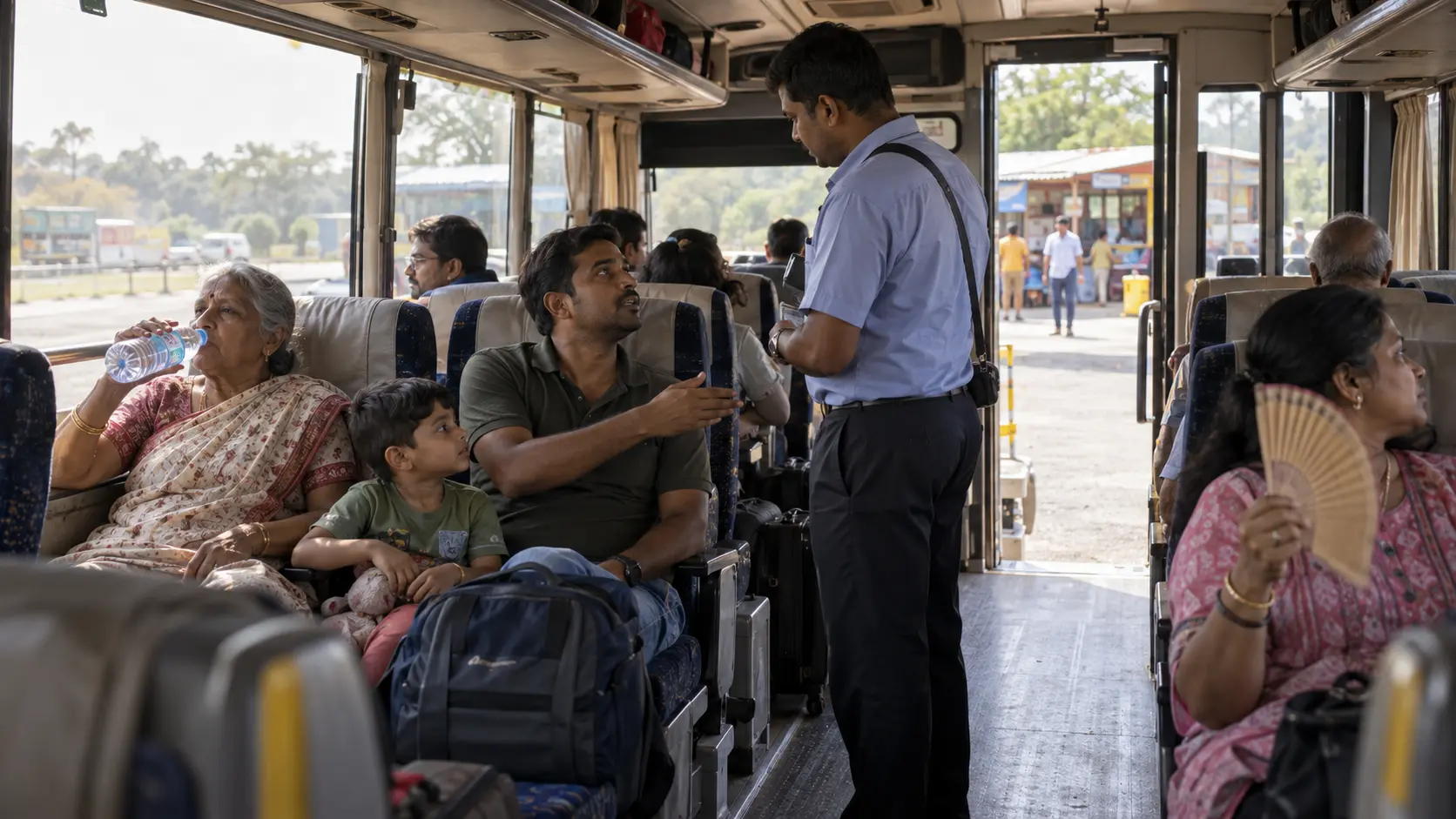
You booked an air-conditioned intercity bus, paid the fare shown for that service and settled into the journey. Soon after departure the cooling stops, vents blow warm air or the driver says the system cannot be repaired until the next city. The practical response depends on more than discomfort. Weather, ventilation, passenger health, trip length and the operator’s response determine what should happen next.
This guide uses a “protect, report, record, remedy” structure. It does not promise a full refund whenever an amenity fails. It helps travellers manage immediate risk, establish what was sold and request a proportionate solution supported by evidence.
Protect: decide whether this is discomfort or a safety issue
Check the cabin conditions. Are windows sealed? Is ventilation working? Are children, older adults, pregnant passengers or people with medical conditions becoming unwell? Warning signs such as fainting, confusion, breathing difficulty, chest pain or severe dehydration require prompt help. Tell the crew clearly and seek emergency medical assistance where needed.
Drink water, reduce unnecessary layers and move away from heat sources if the crew permits. Do not open emergency exits, block the aisle or interfere with the driver. Passenger frustration must not create a road-safety hazard.
Report: give the crew a chance to respond
Inform the conductor or driver once, calmly and specifically: “The vents in rows 8–12 are blowing warm air and the cabin is becoming hot.” Ask whether the AC has tripped, whether ventilation can be restored, and whether a safe repair stop or replacement bus is planned. Record the time and location.
A short interruption after a restart is different from a system that remains off for hours. Give the crew reasonable time to diagnose it, but request updates rather than accepting repeated “five more minutes” estimates with no action.
Record: prove the promised service and actual condition
| Evidence | What it establishes | Privacy-safe method |
|---|---|---|
| Ticket and listing | AC service was advertised | Save fare, bus type and amenities |
| Time-stamped message | Problem reported during journey | Use operator’s official channel |
| Short photo or video | Vents/display/crew response | Avoid passengers’ faces |
| Location and duration | How much of trip was affected | Note towns, tolls or timestamps |
| Replacement expense | Direct financial consequence | Keep invoice or receipt |
A thermometer reading may add context, but a phone sensor is not always accurate. Do not make medical or technical claims you cannot support. The strongest facts are the advertised bus type, the crew’s acknowledgement, duration and response.
Build a journey timeline
- Departure time and boarding point.
- When cooling stopped or became ineffective.
- First report to crew and response.
- Any restart, repair stop or passenger transfer.
- Conditions after each intervention.
- Arrival time and total affected duration.
Write this during a safe stop or after arrival, not while standing near the driver. A simple timeline is more persuasive than dozens of repetitive videos.
What remedy is reasonable during the trip?
Ask first for restoration of the promised service. Depending on location and feasibility, that might mean restarting the unit, opening safe ventilation, moving affected passengers, repairing at a depot, transferring to another AC vehicle or allowing passengers to leave at a safe staffed stop. The operator must also consider road safety and vehicle availability.
If you choose to leave, tell the crew and operator in writing, collect your luggage and confirm the exact stop. Do not exit on a highway shoulder merely to strengthen a complaint. Personal safety comes first.
How much refund should you request?
A full refund may be easier to justify if the promised AC service failed for most of the journey and the trip became unusable or unsafe. A partial refund may be more proportionate where transport was completed but a priced amenity was unavailable for a material period. The applicable ticket terms, operator policy and evidence matter.
Calculate rather than guess. Note the total fare, any visible price difference between AC and non-AC service on a comparable route, percentage of journey affected, and direct replacement cost. A platform may use its own compensation framework, but your calculation shows why the request is reasonable.
A proportionality matrix
| Scenario | Practical request | Supporting proof |
|---|---|---|
| Brief interruption, fixed promptly | Service feedback | Timeline |
| AC off for substantial segment | Partial fare adjustment | Ticket, duration, crew report |
| Bus replaced and delay caused | Review direct delay expenses | Transfer and arrival record |
| Trip abandoned at safe stop | Unused fare plus reasonable onward cost | Exit confirmation and receipts |
| Health emergency | Immediate assistance; later documented claim | Medical record and incident timeline |
This is a reasoning tool, not a guaranteed compensation schedule.
Operator, platform and bus owner: who handles what?
The bus operator controls the vehicle and crew. A booking platform may have displayed the amenity, collected payment and provided support. The bus owner or contractor may be another entity. Send the incident first through the ticket’s official support route and identify the operator name, service number, registration and platform booking reference.
Ask the operator to confirm the technical incident and steps taken. Ask the platform to preserve the original listing and decide the fare remedy. Do not accept endless referrals; place both responses in the same written chronology.
A complaint that avoids overclaiming
Subject: AC service unavailable for material part of journey – booking [masked reference]. I booked the advertised AC service from [origin] to [destination] on [date]. Cooling stopped at approximately [time/location] and was reported to the crew at [time]. The response was [brief factual description]. Service was restored at [time/not restored], affecting about [duration/portion] of the journey. Attached are the ticket, listing, time-stamped report and arrival record. Please confirm the incident and provide a written decision on a proportionate fare adjustment plus the attached direct expense, if applicable.
Avoid accusing the crew of deliberate misconduct unless evidence supports it. Describe the condition and action taken.
When fellow passengers want to complain together
A joint factual statement can confirm duration and crew response. Each traveller should still keep their own ticket and request. Do not publish passenger phone numbers or identity documents. One person may collect masked booking references with consent, but support should process each payment separately.
Do not pressure passengers to sign a statement they did not read. Independent, consistent timelines are more useful than copied allegations.
Health-related documentation
If medical care was required, keep the consultation record, bill and transport receipt. Ask the clinician to document the actual symptoms and treatment rather than attributing cause beyond their assessment. A hot cabin and a later illness occurring together do not by themselves prove medical causation.
Travellers with heat-sensitive conditions should carry prescribed medication and discuss travel with a qualified clinician. This article cannot determine whether an individual should continue the journey.
If the operator marks the complaint “resolved” without a decision
Reply with the case number and ask what remedy was approved or why it was denied. Request the relevant ticket or amenity clause. A closure message is not the same as a reasoned response. Escalate through the platform or operator’s grievance officer when the normal channel cannot explain the outcome.
Public reviews: useful, but protect your case
A concise review can warn travellers about a dated experience, but it should not replace the formal complaint. State the route, date, advertised amenity and response accurately. Remove booking numbers, staff phone numbers and passengers’ faces. Update the review if the operator later resolves the matter.
Do not use threats, discriminatory language or claims of criminal conduct without evidence. Neutral documentation is both safer and more useful to readers.
Before booking the next overnight bus
- Save the listing showing AC type and boarding details.
- Check whether the bus has sealed windows.
- Carry water and essential medication.
- Prefer staffed boarding and drop points.
- Keep operator and platform contacts offline.
- Share the journey with a trusted person.
- Choose seats appropriate for mobility and health needs.
If luggage is unloaded during a replacement
Count every bag before the original bus leaves. Match luggage tags, photograph the replacement registration and ask which vehicle will carry checked items. Keep medicines, documents, valuables and essential electronics with you. If a bag is missing, report it immediately to both crews and the operator with a description and tag number.
A breakdown transfer can become chaotic, so one traveller should watch luggage while another confirms seats. Do not allow urgency to separate children or dependent passengers from their accompanying adult. Record the transfer time and any additional fare demanded; request a receipt rather than paying an unexplained cash amount.
Escalation options in India
Start with the operator and booking platform. For an unresolved consumer dispute, the National Consumer Helpline offers a pre-litigation channel through its portal and 1915. State transport authorities may have complaint systems for permitted operators; use the official state government site applicable to the bus. For an alternative rail journey, use IRCTC’s official website.
Ask for the narrow remedy supported by the record: fare adjustment, unused-fare refund, or documented reasonable expense. Keep the complaint about the specific trip.
Official resources
This article provides general travel and consumer information, not medical or legal advice. In a health or safety emergency, seek appropriate local assistance immediately. Refunds and compensation depend on the ticket terms, facts and applicable rules.
Leave a Reply