
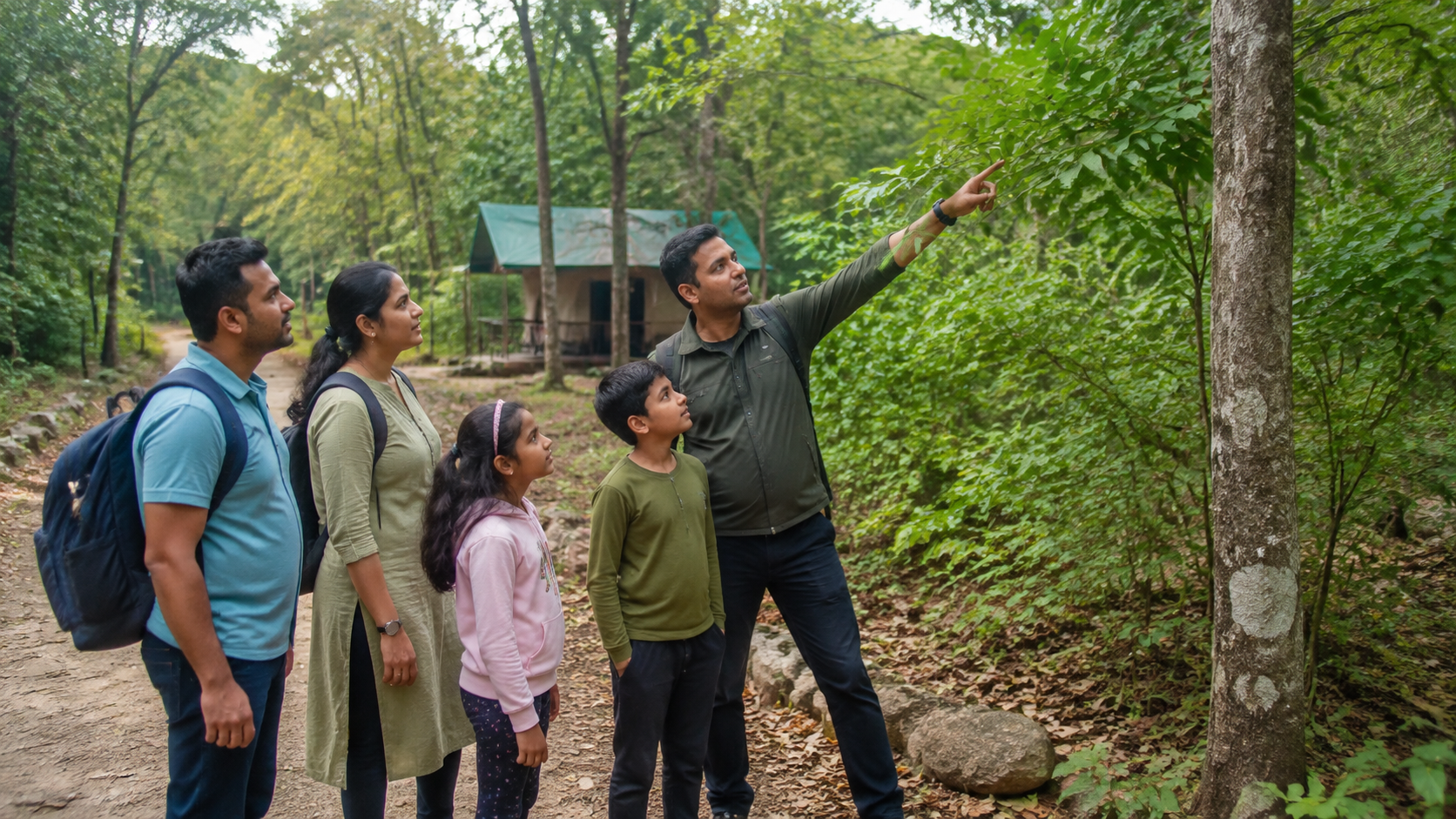
Can a family comfortably visit Kilad Nature Education Campsite? Yes—especially when children enjoy forests, observation and simple outdoor learning. But Kilad is better understood as a nature-education setting than as a conventional holiday resort. Its usefulness depends on advance coordination, realistic expectations about facilities, and a programme designed around children’s energy rather than a checklist of attractions.
Kilad is associated with the forest landscape around Vansda in South Gujarat and is described by Gujarat Tourism as a nature education campsite. Older published descriptions mention tented accommodation, separate bathing and toilet facilities, an orientation centre, a dining area and trails, but families must reconfirm which services are currently operating. Do not arrive expecting a room, meal or guided activity without a confirmed booking.
Build the visit around three small learning missions
Children usually remember a forest better when they have a purpose. Instead of repeatedly telling them to “look at nature,” give them three quiet missions: identify five leaf shapes without plucking leaves; listen for three different bird calls; and note how shade, moisture and plants change along the route. A notebook makes the day active without disturbing wildlife.
A second mission can focus on responsible travel. Let children carry a reusable waste pouch, measure how much single-use plastic the family avoided, and check that nothing is left behind. A third can be a family sketch or photo record. Avoid flash photography, loud music and attempts to handle insects or plants.
Who will enjoy Kilad—and who may struggle?
Preschool children
A short morning visit can work, but parents need a carrier and close supervision. Natural ground may include roots, loose soil, stones and wet leaves. A stroller cannot be assumed to work on trails. Keep the plan to one easy activity, a snack and rest; a tired toddler in a remote forest quickly turns an educational visit into a difficult one.
Children aged 7–13
This is the strongest fit. They can follow instructions, use a simple field sheet and understand why a forest is not a playground. School lessons about food chains, soil, water and biodiversity become easier to understand when children can observe the setting directly.
Teenagers
Teenagers may enjoy photography, mapping and ecology more than a guided lecture. Ask them to plan a low-impact family activity or compare tree cover and temperature between a shaded and open area. Mobile signal should not be treated as dependable; download reference material beforehand.
Grandparents
Seniors can enjoy the orientation area and shortest trail if surfaces and weather are suitable. Ask staff about steps, slopes, benches, toilet distance and vehicle access before confirming the trip. A family should never pressure a grandparent to finish a forest trail simply to stay together.
Day visit or overnight?
First-time families should consider a day visit unless they have clearly confirmed accommodation, meals, bathrooms, bedding and on-site support. A day programme is easier to control: arrive early, attend orientation if offered, complete one short trail, eat a planned meal and depart before late afternoon.
An overnight stay can be rewarding for older children who are comfortable with basic facilities and forest sounds. It needs more preparation. Ask whether tents are currently available, whether families or only organised groups are accepted, how bathing areas are arranged, whether lighting continues overnight, and who remains on site in an emergency.
Do not assume older blog details remain current. A description from several years ago can help form questions, not confirm today’s inventory.
Walking, weather and the reality of forest terrain
Kilad should not be described as step-free or wheelchair accessible without current confirmation. Nature trails change after rain and maintenance. Expect irregular ground, low branches, insects and patches that may be muddy. Closed shoes with tread are safer than flip-flops. Children should walk between adults rather than racing ahead.
During monsoon, the landscape becomes greener but wet leaves, mud and moss increase slipping risk. Streams and drainage channels can rise quickly. In hot months, humidity and heat exhaustion become the bigger concern. The most comfortable general window is usually October to February, with March possible for an early visit. Always check forest access and weather shortly before departure.
Food, water and toilets: confirm before you promise children
Older descriptions refer to a dining area, and one older local account says meals were more readily arranged for groups than individuals. That is not enough to promise food. Ask whether meals are available on your date, whether advance ordering is compulsory, and what is included. Carry simple backup food even after receiving a confirmation.
Vegetarian meals are likely to be easier to arrange than specialised menus, but Jain food must be requested precisely. Explain whether onion, garlic and root vegetables are excluded. Families managing allergies should bring clearly labelled safe food because a basic group kitchen may not be able to prevent cross-contact. Do not depend on non-vegetarian food being available.
Carry sealed drinking water for the journey and first activity. Ask which on-site water is treated. Separate toilet and bathing facilities have been mentioned historically, but current cleanliness, water supply and accessibility require confirmation. Keep tissue, sanitiser and soap in the day bag.
A practical route plan from three Gujarat cities
From Surat: Road travel by private car or hired cab is the most flexible option. Kilad is a South Gujarat forest destination, and the final segment is not usefully solved by rail. Leave early enough to reach in daylight, use current navigation and save the route offline.
From Vadodara: The drive is long for a simple day visit. Consider staying near a suitable South Gujarat base and visiting Kilad the following morning. Train travel can reduce the main-road journey only if a dependable cab is booked from a practical railhead; spontaneous last-mile transport is a poor family plan.
From Ahmedabad: Make it part of a two- or three-day South Gujarat itinerary. A train towards Surat, Navsari or another suitable station followed by a pre-arranged car may be more comfortable than one continuous drive. Flying rarely saves useful time after transfers and the remaining road journey.
Exact distances change with the chosen city neighbourhood, railhead and route. Check the current map and road conditions instead of copying a single number. Avoid forest approaches after dark.
Medical and connectivity planning
A nature campsite cannot offer the same rapid medical access as a city. Carry regular medicines, allergy treatment prescribed for the child, basic first aid and oral rehydration salts. Before arrival, ask staff which functioning health centre they currently use and record the route offline. If a family member needs rapid specialist care, choose a less remote outing.
Signal strength may vary by network and location. Save booking messages, maps and emergency numbers to the phone, and share the itinerary with someone outside the travelling group. Carry charged power banks but conserve phone battery rather than testing reception continuously.
A no-rush schedule that works for children
- 8:30–9:00: Arrive, use toilets and confirm rules.
- 9:00–9:30: Orientation and learning missions.
- 9:30–10:30: Short guided or approved nature walk.
- 10:30–11:00: Water, snack and quiet observation.
- 11:00–12:00: Drawing, bird listening or supervised activity.
- 12:00 onward: Meal and departure before fatigue or afternoon heat.
Times are illustrative, not official. Adjust them to the booking, season and staff guidance. One good trail is more valuable than pushing children through every available activity.
Transparent family budget method
Current official entry, accommodation, guide and meal charges were not confirmed for this guide. Ask for a written quote before travelling. Build the total from return vehicle cost, tolls, confirmed campsite or activity fee, food, water and an emergency margin. If staying overnight, add bedding or equipment charges only after the operator confirms them.
For a family of four using its own car, fuel will depend on actual return kilometres and vehicle mileage. A hired cab quote should include waiting time. Carry some cash because remote digital payment can fail, while avoiding unreceipted or unexplained charges.
Kilad learning-trip packing list
- Booking confirmation and identification
- Closed shoes, spare socks and light rain protection
- Two litres or more of family drinking water depending on weather
- Simple backup lunch and allergy-safe snacks
- Notebook, pencils and child-safe binoculars
- Hat, sunscreen and child-appropriate insect repellent
- Personal medicine, first aid and oral rehydration salts
- Tissues, soap and hand sanitiser
- Power banks and offline maps
- Reusable waste bags
When I would postpone Kilad with children
Postpone when heavy rain or a weather alert affects the forest, staff cannot confirm access, a child is ill, or the family would reach after daylight. I would also avoid an overnight stay when accommodation, bathrooms, meals and on-site supervision have not been confirmed directly.
Choose a city nature centre instead if a child cannot follow trail instructions, a senior needs a guaranteed step-free route, or someone requires immediate advanced medical support. Kilad’s educational value comes with the realities of a forest setting.
Family FAQs
Is Kilad an amusement campsite?
No. Its main value is nature education, forest observation and simple outdoor activity.
Can an individual family stay overnight?
Do not assume so. Confirm current family booking rules, tent availability and facilities directly before planning.
Is food available?
Meal arrangements may depend on advance notice or group size. Obtain a clear confirmation and carry backup food.
Are toilets available?
Older descriptions mention separate toilet and bathing facilities, but reconfirm current operation, water supply and accessibility.
Can toddlers walk the trail?
Only short easy sections may suit them. Bring a carrier and be prepared to turn back.
Will we see wildlife?
Possibly, but no sighting is guaranteed. Quiet observation of plants, birds and forest signs is a better expectation.
How long is enough?
Four to five hours works for a first family day visit. One night suits prepared families after a confirmed booking.
Accuracy note: Kilad’s accommodation, meals, activities, charges and access can change. Reconfirm every operational detail with the responsible forest or eco-tourism contact shortly before travel.
Nearby Places You May Also Like
Continue planning your South Gujarat trip with these nearby family-focused guides:
Leave a Reply