
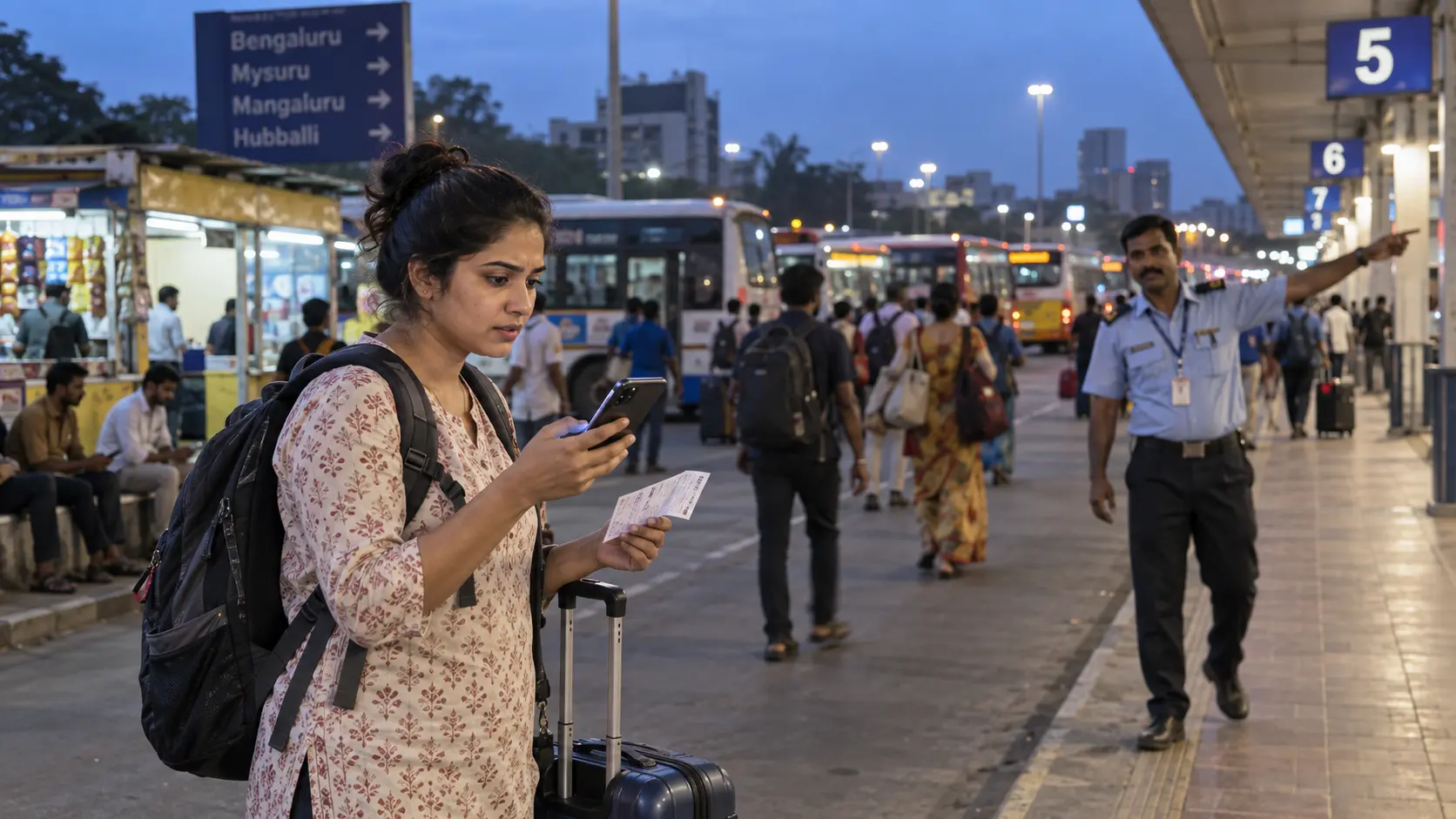
BUS TRAVEL • BOARDING LOCATION • LATE-NIGHT SAFETY
A bus ticket may show a landmark, map pin and reporting time, yet the vehicle may stop on another service road or at an operator office with a similar name. When calls go unanswered and the bus leaves, the traveller faces two problems at once: reaching safety and proving that the published boarding information failed. The correct order is safety first, evidence second and refund arguments third.
This is a field playbook for app-booked intercity buses in India. It does not assume the platform or operator is automatically responsible for every missed departure. It shows how to verify a pickup point, document conflicting instructions and make a precise request when the vehicle does not arrive where the ticket directed.
T-minus 24 hours: convert a label into a real place
Do not rely on a name such as “Central Circle,” “Highway Junction” or “Near Hotel.” Open the ticket and capture the written address, map pin, landmark, boarding time, reporting time, operator phone number and vehicle details. Search the landmark on a separate map. If the pin and written address point to different roads, contact support before travel.
Call the operator using the number on the confirmed ticket. Ask: “Which side of the road? In front of which shop or building? Does the bus enter the service lane? Is there an office board? What time does the boarding coordinator arrive?” Record the answer in a note. A map link sent by an operator is useful, but open it immediately and confirm the district and direction.
A boarding point has five coordinates
| Coordinate | What to verify | Common ambiguity |
|---|---|---|
| Name | Exact stop or office name | Two branches with similar names |
| Pin | Latitude and longitude on the ticket | Pin placed across a flyover |
| Road side | Direction of travel | Opposite carriageway is inaccessible |
| Landmark | Visible permanent reference | Temporary shop has closed |
| Contact | Working coordinator number | Call centre cannot see live vehicle |
Saving all five turns a vague disagreement into a checkable location problem.
T-minus 90 minutes: plan the last kilometre
Allow extra time for traffic, rain, road works and searching. Tell your taxi or auto driver the direction of the bus route, not only the landmark. If the stop is on a highway shoulder, identify a safe waiting area with lighting and other passengers. Families, solo travellers and older adults should avoid crossing fast traffic with luggage merely to chase a moving vehicle.
Share the ticket and live location with a trusted person, but mask the complete booking reference in public groups. Carry a charged phone, power bank and enough funds for a safe fallback. The cheapest ticket is not worth waiting alone at an unlit roadside after midnight.
T-minus 30 minutes: create proof without becoming distracted
- Take one wide photo showing the landmark and road.
- Capture your map position and time.
- Call the coordinator and operator; retain the call log.
- Send a written message: “I am at the ticketed boarding point.”
- Ask for the vehicle number and live arrival estimate.
- Speak with other listed passengers if they are present.
Do not film strangers closely or obstruct traffic. Evidence should establish location and time, not create a privacy or safety problem.
When the app, operator and driver give different instructions
Use the safest official instruction you can verify. If the operator asks you to move, request a map pin and written confirmation that the bus will wait. Estimate walking or driving time before agreeing. A request to cross a divided highway or enter an isolated lane deserves caution. Tell the coordinator if the move is unsafe and ask for the vehicle to stop at the ticketed point.
Keep screenshots because live boarding details can change after departure. Note the time of each instruction. Do not edit images; preserve originals with metadata.
The bus is late: delay or location failure?
A late bus has not necessarily missed the point. Ask for a revised arrival time and live vehicle status. A location failure occurs when the bus uses another point, passes without stopping, or the ticket directs passengers to a place the operator does not serve. The distinction affects the remedy.
Wait only where it remains safe. If the published support channel gives no reliable update and conditions become risky, move to a staffed, lit place. Send a message explaining that you left the roadside for safety and give the nearby location where you can be reached.
The vehicle has left: freeze the record
Within a few minutes, save the ticket, boarding instructions, map screen, location photo, call log and messages. Ask the operator in writing whether the vehicle stopped at the published point, at what time and who attempted to contact you. If the operator says you were a no-show, request its GPS stop record or boarding coordinator log. You may not receive internal data, but the question identifies the disputed fact.
Do not immediately cancel the booking inside the app unless support instructs you in writing. A voluntary cancellation can obscure a complaint that the service was not available at the stated point.
Choose a safe recovery plan
If travel is essential, compare the next official bus, railway option and safe overnight stay. Book through a recognised channel and retain the invoice. Choose a reasonable alternative, not an unnecessary luxury upgrade. If it is after midnight, personal safety may justify a taxi home or to a staffed station; document the route and receipt.
Never chase an intercity bus at speed or accept an unverified private vehicle claiming to be the operator’s replacement. Confirm any replacement registration number through the ticketed operator.
Calculate a defensible claim
| Item | When it may be relevant | Evidence |
|---|---|---|
| Unused bus fare | Vehicle did not serve published point | Ticket and operator reply |
| Reasonable alternative fare | Urgent travel required replacement | New ticket and timeline |
| Safe return transport | Traveller stranded late at night | Taxi receipt and location record |
| Separate programme loss | Directly documented, subject to terms | Invoice and causation record |
Requesting a cost does not guarantee reimbursement. Start with the unused fare and documented direct expense. Avoid inflated figures for distress; they can distract from the strongest evidence.
A complaint built around one disputed fact
Subject: Bus did not arrive at published boarding point – booking [masked reference]. My ticket directed me to [exact address/pin] by [time]. I arrived at [time], and the attached photo and map record show my location. I called the listed numbers at [times] and sent the attached message. At [time], I learned that the vehicle had used [different point/passed without stopping]. Please confirm the vehicle’s stop record and the boarding point supplied to the driver. I request refund of the unused fare and a written decision on the attached reasonable replacement/return expense.
Keep the language factual. Do not label the operator dishonest unless reliable evidence supports that claim.
If the platform says “contact the operator”
The operator controls the vehicle, but the platform displayed and sold the itinerary. Ask each party for the information it owns. The operator should address vehicle movement and calls; the platform should preserve the listing, map pin, transaction and complaint. Put both references in one chronology.
If an automated response closes the case, use the platform’s published grievance channel. Ask for a human review of the location evidence, not a generic cancellation policy.
Prevent the same failure on another route
- Prefer boarding points at staffed offices or recognised terminals.
- Read recent route-specific comments without treating them as guaranteed facts.
- Verify the road side and direction before leaving.
- Save the operator number offline.
- Arrive early enough to correct a pin error.
- Carry a safe fallback for late-night departures.
The 20-minute station check
If the stop is near a large terminal, do not assume the bus uses the main gate. Ask uniformed terminal staff whether the named private operator has an assigned bay, but treat informal directions as guidance rather than proof. Check arrival boards, operator counters and the registration number shown in the app. A vehicle may display a partner brand that differs from the seller name, so confirm the registration and route before boarding.
When several buses leave for the same city, never hand luggage to a helper until the conductor confirms your ticket. Photograph the luggage tag, keep valuables with you and verify the destination before the bag enters the hold. These small checks solve a boarding-location problem without creating a baggage problem.
Official help
For unresolved consumer disputes in India, the National Consumer Helpline accepts pre-litigation grievances through its portal and 1915. State transport department or operator-specific complaint systems may also apply. For rail alternatives, use the official IRCTC website rather than links sent by unknown callers.
This guide provides general travel and consumer information. Boarding arrangements, remedies and liability depend on the ticket terms, evidence and local rules. In an immediate safety emergency, contact local emergency services.
Leave a Reply