
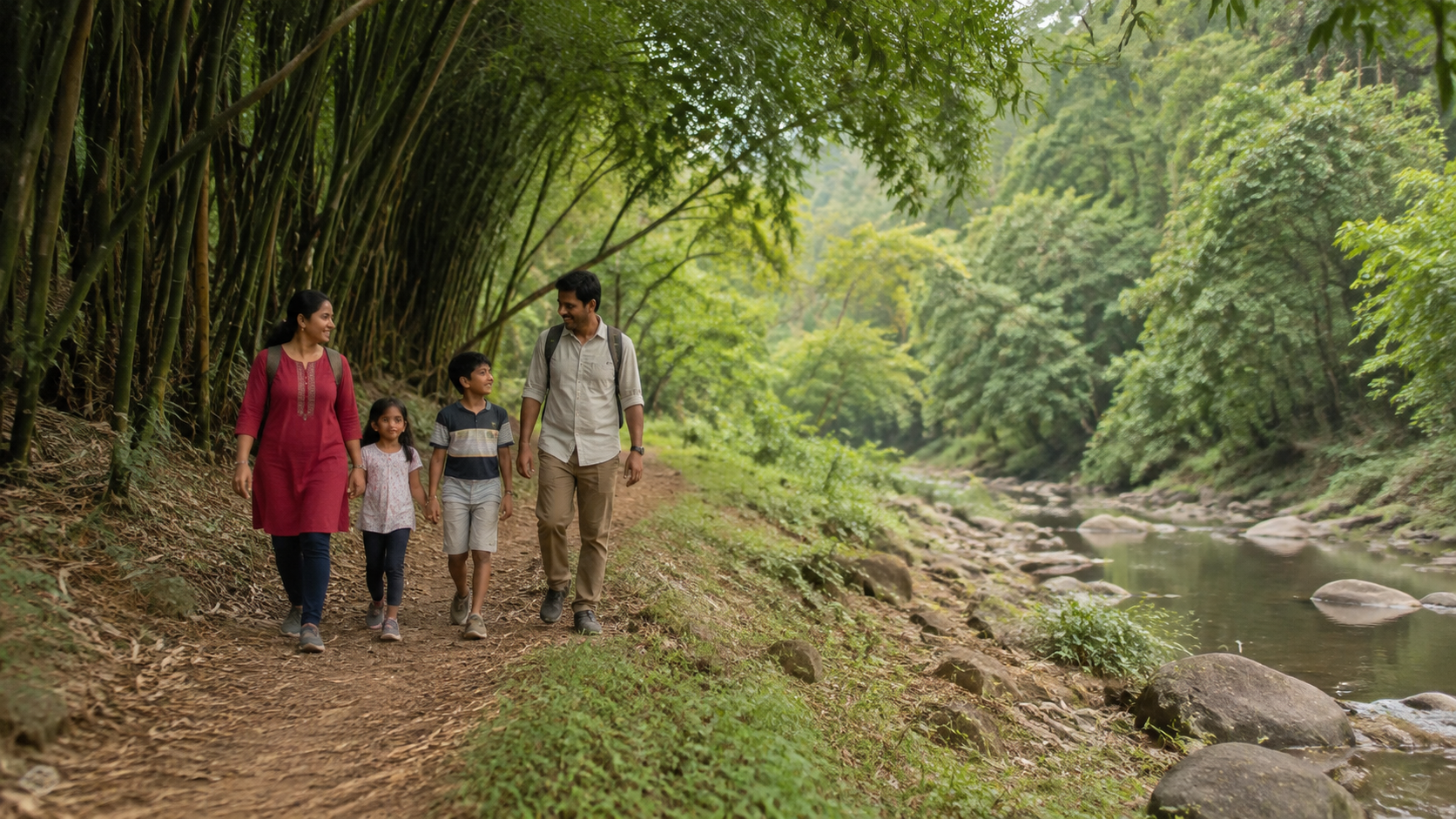
Quick answer: Mahal Eco Campsite can work very well for a family that enjoys forests, riverside scenery and unhurried outdoor time. It is not a resort-style attraction, however. Parents should expect a remote forest setting, limited shopping nearby, walking on natural surfaces and changing conditions during rain. The easiest family visit is an organised overnight stay between October and March, after confirming accommodation and meals directly with the campsite or the local eco-tourism committee.
First decide whether your family enjoys a quiet forest stay
Mahal is on the bank of the Purna River inside the wider forest landscape of Purna Wildlife Sanctuary in the Dang district. Gujarat Tourism describes bamboo, moist deciduous forest, birdlife, walking and trekking as the main appeal. That tells parents something important: the value of Mahal comes from being in nature, not from rides, shopping streets or a long list of built attractions.
Children who like spotting leaves, insects, birds and river landscapes may stay interested for hours. A child expecting a swimming pool or amusement activities may become bored. Discuss the plan before leaving: a slow walk, time at the orientation centre, supervised observation from a machaan and a quiet evening are realistic expectations. Wildlife sightings are never guaranteed.
A family fit check by age
Toddlers and preschoolers
A toddler can accompany adults, but this is the age group that requires the most work. Natural trails are not reliable stroller territory. River edges, uneven ground and steps around viewing structures require continuous hand-holding. Carrying a child for part of a trail may be necessary. Choose a cottage with an attached bathroom rather than tented accommodation if available, keep the programme short and return before the child becomes overtired.
Children aged 6–12
This is probably the most rewarding age. School-age children can understand forest rules, use a simple bird checklist and walk moderate distances with breaks. Turn the orientation centre into the beginning of the visit rather than skipping it. Ask children to identify bamboo, listen for different bird calls and record what they see without collecting leaves, stones or insects.
Teenagers
Teenagers who enjoy photography, hiking or ecology should find Mahal engaging. Those who mainly want fast internet may not. Give them responsibility for a small route plan, family nature log or photography project. Night trails should only be attempted when the campsite offers an authorised guide; a family should not independently enter forest paths after dark.
Grandparents
Seniors can enjoy the calm landscape without completing every trail. The practical questions are balance, knee comfort, bathroom proximity and the ability to manage steps. Request a ground-level cottage near the dining area, ask about the distance from parking to the room and avoid a rushed multi-stop itinerary. Anyone with heart, breathing or mobility concerns should seek personal medical advice before a remote stay.
What will the walking actually feel like?
The official destination information lists a nature trail and viewing machaans. Walking distance and surface condition can vary with the chosen activity and weather, so Mahal should not be described as uniformly accessible. Expect soil, stones, roots, leaf litter and occasional slopes rather than a continuous paved promenade. After rain, mud, moss and wet wooden or stone surfaces can become slippery.
Closed shoes with grip are more useful than sandals. Parents should keep children between adults on narrow sections and away from unsupervised river access. A walking stick can help an older traveller, but it does not make a difficult route accessible. Ask staff for the shortest suitable circuit; turning back early is a sensible family decision, not a failed visit.
Accommodation and facilities: useful, but reconfirm them
Gujarat Tourism currently lists four air-conditioned cottages with attached bathrooms, tented accommodation with separate bathing and toilet facilities, a kitchen and dining area, an orientation centre, nature trail, campfire space and two-storey machaans. These details make an overnight family visit possible, but inventory, maintenance, meal arrangements and seasonal operation can change.
Do not arrive with children assuming a room will be available. Confirm the booking channel, check-in time, bedding, hot water, power backup and whether towels and toiletries are supplied. The site uses solar-generated electricity, so conserve power and carry charged power banks. Families who need a particular medication refrigerated should ask about dependable refrigeration before booking.
Food, drinking water and special diets
A separate kitchen and dining area is listed, but parents should confirm whether meals must be ordered in advance and whether the kitchen serves walk-in day visitors. Ask for the exact meal plan, serving times and current price. Vegetarian food is usually the simplest request in rural Gujarat, yet Jain food, allergy-safe preparation or a guaranteed non-vegetarian menu should never be assumed.
Explain Jain requirements clearly, including no onion, garlic or root vegetables if that is your practice. For allergies, carry safe backup food because cross-contact controls may not match a city restaurant. Bring enough sealed drinking water for the drive and first part of the stay; then ask staff which water is treated or packaged. Do not drink directly from the river or an unverified tap.
Comfort details parents often discover too late
- Mosquitoes and insects: Forest and riverside conditions mean insects are normal, particularly around dusk and after rain. Use child-appropriate repellent, long sleeves and closed footwear. Check beds and shoes before use without harming wildlife.
- Heat and humidity: Even in a pleasant season, walking can feel warm. Start early, use hats and schedule water breaks.
- Mobile signal: Do not build the trip around continuous connectivity. Network performance can differ by handset and exact location. Download maps and booking details before leaving the last larger town.
- Medical access: Mahal is a remote nature destination, not a place to rely on immediate specialist care. Carry regular medicines and a first-aid kit, and ask the operator which currently functioning health centre or hospital they use in an emergency. Do not publish or depend on an unverified “nearest hospital” name.
A sensible journey from Surat, Vadodara or Ahmedabad
From Surat: A private car or hired cab is usually the most practical family option because the final journey is by road and local transfers are limited. Plan a south-east route towards the Dang region and use live navigation for current road conditions. Distance estimates vary with the starting neighbourhood and route, so confirm on the day rather than treating a blog figure as exact.
From Vadodara: The drive is considerably longer. A direct cab gives control over food and toilet breaks. Rail can help only as part of the journey: travel to a useful South Gujarat railhead and continue by pre-arranged road transport. This is rarely simpler than driving for a family carrying overnight luggage.
From Ahmedabad: Treat Mahal as an overnight or two-night trip, not a casual day outing. Driving all the way is possible for experienced drivers but tiring. A train to Surat or another suitable South Gujarat station followed by a reserved cab can divide the journey. Flying is generally poor value for this destination once airport formalities and the long road transfer are included.
Whichever city you start from, avoid beginning the forest approach late at night. Refuel earlier, save the location offline and tell the property your expected arrival time.
Best family season and realistic duration
Gujarat Tourism recommends October to March. These months usually offer more comfortable walking conditions than peak summer. The monsoon creates intense greenery, but rain also brings muddy tracks, stronger river flow, insects, reduced visibility and possible road disruption. Families visiting in or soon after heavy rain should call locally for current access conditions.
One night is the useful minimum: arrive in daylight, settle in, take a short orientation walk, enjoy the morning forest and leave without rushing. Two nights suit families travelling from Ahmedabad or wanting a slower schedule. A day trip is possible from closer parts of South Gujarat, but much of the day may disappear in the car.
Transparent budget example for a family of four
For two adults and two children travelling from Surat in a private car for one night, build the estimate in parts: fuel and tolls based on your actual route; cottage charge quoted by the campsite; four meals plus snacks; guide or activity charge if applicable; and a 10–15% contingency. Without a current official booking tariff, publishing one total would create false precision.
As a planning method, obtain the room-and-meal quote first, calculate the return kilometres using your vehicle’s real mileage, then add tolls shown by the chosen map route. Reconfirm any entry, parking, guide or camera charge when booking. Carry both digital payment and some cash because remote payment connectivity can fail.
Family packing checklist for Mahal
- Government ID and booking confirmation saved offline
- Closed walking shoes plus spare socks
- Light rain protection when showers are possible
- Child-appropriate mosquito repellent and long-sleeved clothing
- Refillable bottles and sealed water for the road
- Simple snacks and allergy-safe backup food
- Personal medicines, oral rehydration salts, bandages and antiseptic
- Hat, sunscreen and a small torch for each adult
- Power banks, offline maps and emergency contacts on paper
- Small binoculars or notebook instead of loud entertainment devices
- Reusable bag for carrying every piece of waste back
When I would avoid taking children here
I would postpone the visit during a severe-weather alert, immediately after prolonged heavy rain, when forest staff report access restrictions, or when a child is unwell. I would also avoid arriving without confirmed accommodation, attempting a night forest walk without an authorised guide, or travelling with a family member who requires rapid access to advanced medical care.
Very young children who constantly run towards water or cannot follow instructions may be better served by a more controlled nature park first. Mahal can be meaningful precisely because it remains a forest environment; parents should not expect the landscape to behave like a fenced urban attraction.
Parent FAQs
Is Mahal Eco Campsite safe for children?
No nature destination is completely safe. Children can visit with close adult supervision, appropriate footwear and respect for staff instructions. River edges, natural trails, insects and remote access require more attention than a city park.
Can we take a stroller?
A stroller may help near a room or firm common area, but parents should not rely on it for nature trails. A toddler carrier may be more practical if the adult can use it comfortably.
Are toilets available?
Official information lists attached toilets for cottages and separate bathing and toilet facilities for tents. Confirm the current condition and proximity of the facilities assigned to your booking.
Can children swim in the Purna River?
Do not assume swimming is permitted or safe. Currents, depth, submerged rocks and seasonal flow can be difficult to judge. Follow on-site restrictions and keep children away from unsupervised water access.
Can we bring our pet?
No. The official responsible-tourism guidance says pets should not accompany visitors.
Do we need a guide?
A guide is especially valuable for night activity or unfamiliar trails. Ask the campsite which walks require or include an authorised guide and what the current charge is.
Is one night enough?
Yes for most Surat-based families. Choose two nights if the drive is long, grandparents need a slower pace or you want more than one easy nature session.
Planning note: Facilities, access, charges and forest rules can change. Reconfirm them with the official campsite or Dang forest eco-tourism contact shortly before travelling. This guide is for trip planning and does not replace local safety instructions.
Nearby Places You May Also Like
Continue planning your South Gujarat trip with these nearby family-focused guides:
Leave a Reply