
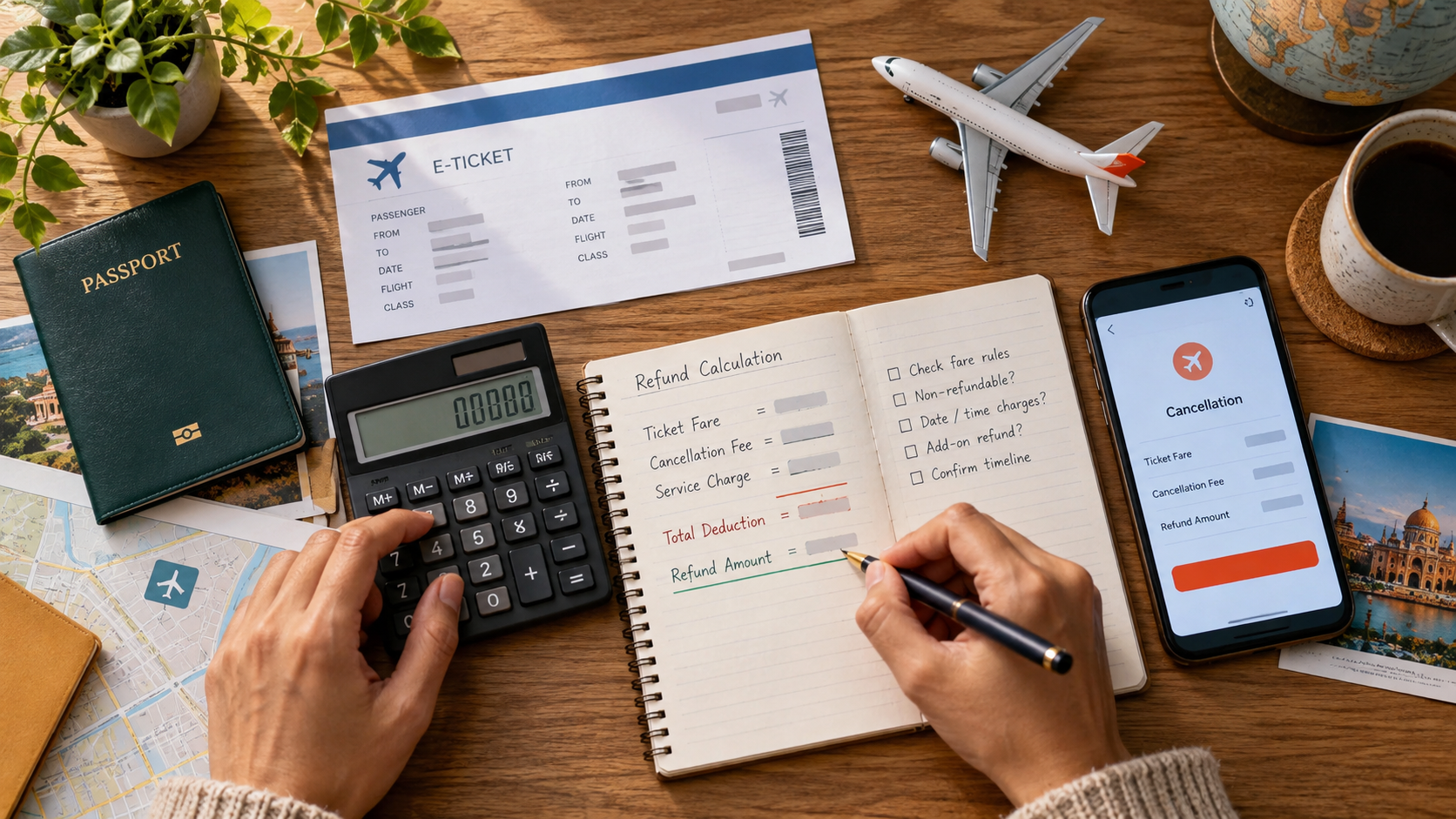
FLIGHT REFUND MATH • CANCELLATION FEES • INDIA
A cancellation screen can turn a simple decision into a confusing subtraction: ticket total ₹12,400, “charges” ₹9,700, estimated refund ₹2,700. The natural reaction is to call the deduction unfair. The more useful first step is to reconstruct the calculation. A flight booking is a bundle of base fare, fuel surcharge, statutory charges, airport fees, convenience fees, add-ons and sometimes an agent service fee. Each component can follow a different refund rule.
This article is organised like a refund audit. You will build a one-page ledger, compare it with the fare rules you accepted, and decide whether to cancel, reschedule or escalate. The examples are hypothetical and deliberately simple; your actual fare family, route, booking time and departure window control the result.
Before pressing Cancel: freeze the evidence
Take screenshots of the cancellation preview, original price breakdown, fare name, date and time. Download the invoice and e-ticket. Record how many passengers and flight sectors are in the booking. “₹3,000 cancellation fee” may mean per passenger per sector: two travellers on a return trip can therefore create four fee units. Do not assume the displayed amount applies once to the complete PNR.
- Booking date and exact time
- Scheduled departure for every sector
- Direct airline or travel-agent booking
- Fare family: basic, value, classic, flex or another label
- Passenger count, including infants where applicable
- Airline fee, portal fee and call-centre fee shown separately
- Add-ons such as seats, meals, insurance and cancellation protection
Build the refund ledger
| Line item | Where to verify it | Question to ask |
|---|---|---|
| Base fare and fuel surcharge | Ticket and fare rules | What is the maximum airline cancellation deduction? |
| Statutory and airport charges | Tax breakdown | Which charges return if the ticket is unused? |
| Airline cancellation fee | Fare-family policy | Is it per passenger and per sector? |
| Portal or agent fee | Checkout terms and invoice | Was it disclosed before payment? |
| Seats, meals and baggage | Add-on conditions | Is each unused service refundable? |
| Protection or insurance | Separate policy certificate | Is this a claim, waiver or non-refundable premium? |
Three clocks control the result
Clock one: time since booking. India’s DGCA requirements provide a look-in period for eligible tickets booked directly on an airline website. The current 2026 revision describes 48 hours to cancel or amend without an additional charge, subject to fare difference for a change. The facility does not apply where departure is less than seven days away for a domestic flight or fifteen days for an international flight.
Clock two: time until departure. Fare rules commonly become stricter within a stated window such as 72, 24 or a few hours before departure. The exact cut-off varies. Missing the cancellation deadline can turn the booking into a no-show, leaving only specified taxes or airport charges refundable.
Clock three: time since the airline changed the service. If the airline cancelled or substantially rescheduled the flight, do not use a normal voluntary-cancellation path without checking the disruption options. An airline-initiated cancellation can carry different refund or rebooking rights from a passenger choosing not to travel.
A worked refund audit
Imagine one domestic passenger paid ₹8,600: ₹4,500 base fare and fuel surcharge, ₹2,200 statutory and airport charges, ₹500 seat and meal, ₹400 portal fee, and ₹1,000 cancellation-protection add-on. The preview shows a ₹3,000 airline fee and ₹300 portal cancellation fee. The correct audit is not “₹8,600 minus ₹3,300” until every other line has been classified.
- Confirm the fare rule permits a ₹3,000 deduction at that departure window.
- Check whether the ₹300 portal fee was disclosed at checkout.
- Ask which statutory and airport charges will return.
- Read the seat and meal conditions rather than assuming they follow the fare.
- Open the protection certificate: it may require a claim for a listed reason instead of automatically refunding its premium.
- Request the final refund amount and destination payment method in writing.
The arithmetic creates questions, not a guaranteed answer. The DGCA’s February 2026 requirements say airline or agent cancellation charges must not exceed the basic fare plus fuel surcharge, excluding a separately disclosed travel-agent charge. They also require statutory taxes and UDF, ADF and PSF to be refunded when a ticket is cancelled, unused or a no-show. That makes an itemised calculation essential.
Cancellation protection is not the same as a refundable fare
Products labelled “zero cancellation,” “free cancellation” or “cancel protection” can work in different ways. One may waive an airline penalty if you cancel before a deadline. Another may reimburse only for specified events after documents are approved. A flexible fare may reduce the fee but still retain a difference. The premium paid for the benefit may itself be non-refundable.
Read four fields: eligible reason, deadline, maximum reimbursement and excluded components. Check whether the benefit applies per passenger, whether partial cancellation is allowed, and whether the airline cancelling the flight changes the treatment. Save the offer page shown at purchase; the short label on the itinerary may omit important conditions.
Cancel, change or keep the ticket?
Compare three numbers on the same day. First, calculate the cancellation refund. Second, calculate the change fee plus fare difference for the new flight. Third, estimate the value of keeping the original booking if your plan is still uncertain. A low original fare can make rebooking surprisingly expensive even when a change fee is modest.
Do not let a support agent cancel while you are merely asking for a quote. Write: “Please provide the cancellation and rescheduling calculations without processing either action.” If only one passenger or one sector needs to change, ask whether the PNR can be split or partially serviced and what happens to the remaining itinerary. This is especially important after one leg has already been flown.
The charge-breakdown request
Subject: Itemised cancellation calculation for PNR [masked reference]. Before I authorise cancellation, please provide the refund for each passenger and sector, showing base fare, fuel surcharge, statutory taxes, UDF/ADF/PSF, airline cancellation fee, agency fee, convenience fee and every add-on. Please identify the fare rule and departure-time band used, confirm whether the booking qualifies for any look-in period, and state the payment method to which the refund will return. This message requests a quotation only and does not authorise cancellation.
When the figures still do not match
Ask the airline to confirm its fee for the ticket number and fare family, then compare that response with the seller’s breakdown. An online portal can have a separately disclosed service fee, but it should not hide the airline amount inside an unexplained total. Save the checkout terms if available, because disclosure at the time of booking is central to evaluating an agent charge.
Escalate through the seller’s grievance officer with one PDF containing the ticket, invoice, cancellation preview, fare rules, airline response and your calculation. For airline grievances, use AirSewa. The National Consumer Helpline offers a pre-litigation grievance route through its portal and 1915. Ask for a defined remedy: a corrected calculation, refund of a particular component, or a written basis for retaining it.
What not to do
- Do not cancel first and investigate later if the preview is unclear.
- Do not compare the fee with the total ticket price without separating taxes and add-ons.
- Do not assume a premium flexible product makes every component refundable.
- Do not open multiple cases with different requested amounts.
- Do not publish your PNR, ticket number, phone number or payment details.
- Do not treat a social-media fee screenshot as the rule for your fare and date.
A better booking habit
Before paying, open the fare rules and take a screenshot of the cancellation amount for your departure window. Multiply any per-passenger, per-sector fee across the whole party. Compare the cheapest fare with a flexible fare using the real cost of one likely change. Book directly when direct servicing and a look-in period matter more than a small price difference. After purchase, inspect the ticket immediately while an early correction window may still be available.
For group travel, nominate one person to keep the booking ledger and support correspondence. Record every quotation with its time because fees and fare differences can change. A shared calculation prevents one traveller from cancelling a sector while another is still comparing alternatives for the same PNR.
Official resources
- Directorate General of Civil Aviation
- Air India official refund guidance
- IndiGo official cancellation guidance
- National Consumer Helpline
- Official grievance portals, including AirSewa
- IRCTC official train booking
This article provides general consumer information, not legal advice. Fare rules, charges and regulatory requirements change. Verify the current policy shown for your exact ticket before authorising cancellation or rescheduling.
Leave a Reply