
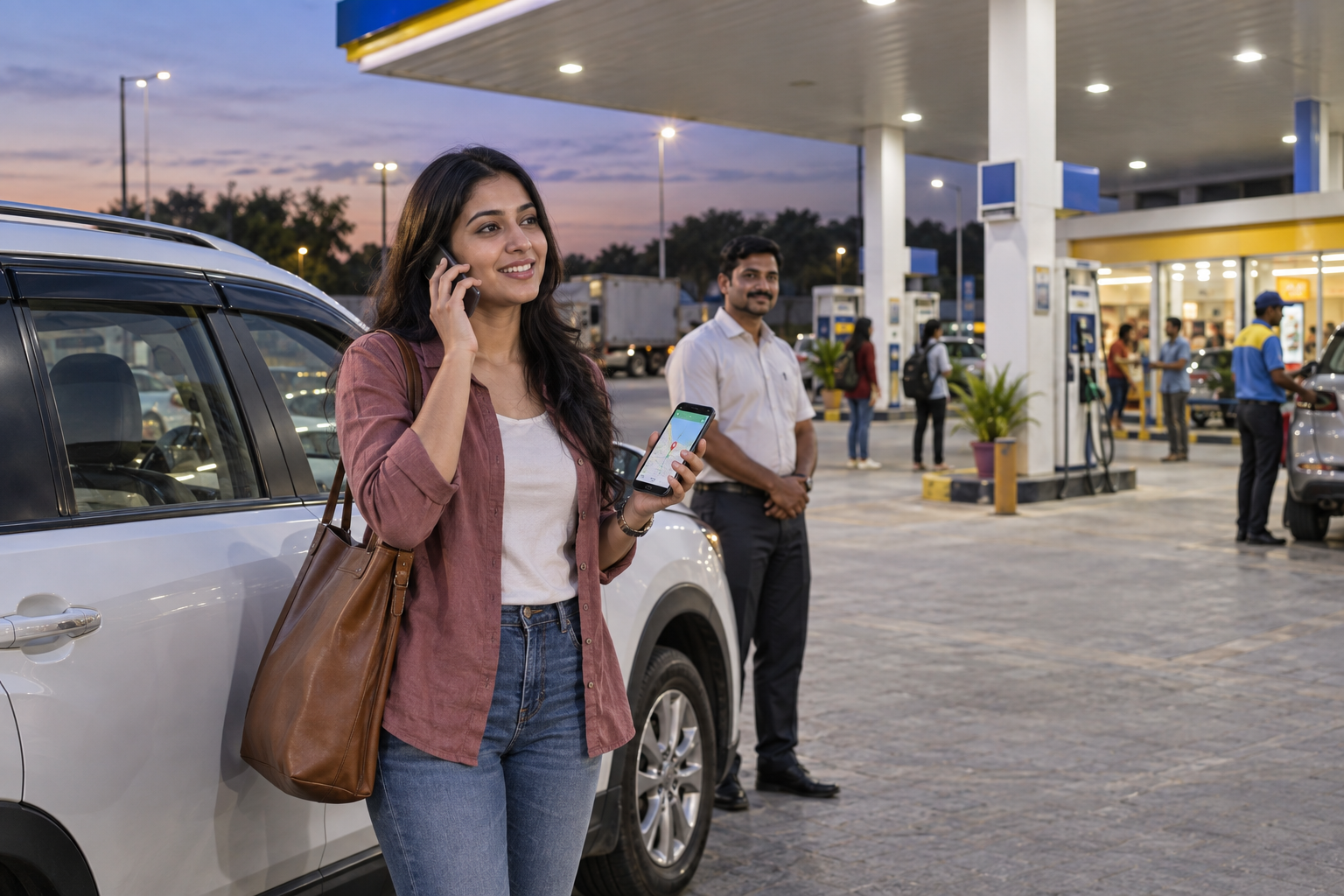
TRAVEL SAFETY • OUTSTATION CAB • EMERGENCY GUIDE
An unsafe cab journey is not merely a customer-service problem. A driver using a phone, speeding, appearing drowsy, refusing a safe route or taking unexplained diversions can create an immediate risk. The correct response depends on the urgency: first reduce danger and reach a safe place, then preserve evidence and pursue the fare or service complaint. This guide gives practical steps for travellers in India without encouraging confrontation inside a moving vehicle.
Decide whether it is an emergency
Use ordinary support channels for a fare disagreement or minor route question. Treat the situation as urgent when there is dangerous driving, threats, harassment, suspected intoxication, refusal to let someone exit safely, movement toward an unknown location, a serious crash or a medical emergency. India’s Emergency Response Support System uses the pan-India number 112 for police, fire, health and other emergencies. Call it only when urgent assistance is genuinely needed.
| Situation | Immediate priority |
|---|---|
| Driver checking phone repeatedly | Ask calmly to stop phone use and pull over safely if it continues |
| Unexpected route | Check live navigation and ask for an explanation while remaining calm |
| Threat or refusal to stop | Share live location and contact 112 when in danger |
| Fare or toll argument | Avoid confrontation while moving; document and dispute later |
| Driver appears drowsy | Request a break at a populated, safe location |
| Collision or medical issue | Move away from traffic if possible and seek emergency help |
Before the vehicle starts
Match the registration number, driver identity and vehicle model with the booking. If they differ, contact the operator before boarding. Photograph or save the app screen, then share the trip details with a trusted person. Sit where you can use the seat belt. Check that luggage does not block doors, mirrors or passenger space. For a family trip, count usable seats after the driver and any authorised guide are included.
Download the route for areas with weak signal. Know the first major highway, planned rest stops and approximate arrival time. Keep your phone charged and carry a power bank. Avoid displaying large amounts of cash. Children should use appropriate restraints where available, and no passenger should travel without a seat merely because the booking description used a broad vehicle category.
If the driver uses a phone while driving
Speak clearly without shouting: “Please keep the phone away while the car is moving. We can stop safely if you need to use it.” Do not grab the phone or steering wheel. If the behaviour continues, ask to stop at a fuel station, toll facility, restaurant or other populated location. Contact the cab operator from there and request another driver or vehicle. A roadside shoulder is not automatically safe, especially at night or on an expressway.
Making videos, scrolling social media and typing messages can be more dangerous than a brief hands-free navigation prompt, but you do not need to debate categories during the trip. Describe exactly what you observed, how often, and whether the vehicle drifted, braked suddenly or missed road signs. Specific facts are more useful than calling the driver “reckless” without details.
When the route changes unexpectedly
A diversion can have a legitimate cause: closure, congestion, flooding, local restrictions or an unsafe road. Compare the live route with the planned route and ask the driver to explain. If the answer is reasonable, update your trusted contact. If the driver refuses to explain, the route moves far from the destination or you feel threatened, ask to stop at a busy safe place and contact the operator. Use 112 when there is immediate danger.
Do not insist on a route that is closed or unsafe merely because the app shows it. Equally, a driver should not add personal stops or large detours without agreement. Note the time, location and explanation. Screenshots of the planned route and actual location can support a later complaint, but never distract yourself from immediate surroundings to collect evidence.
How to leave the vehicle safely
- Choose a populated, well-lit location away from fast traffic.
- Tell a trusted person where you are and keep the call connected if helpful.
- Collect essential belongings only when doing so does not increase danger.
- Do not stand behind or directly in front of the vehicle.
- Arrange replacement transport through an official channel.
- If threatened or prevented from leaving, contact emergency services.
Children, older adults and travellers with disabilities may need extra time to exit. Keep the group together. Do not accept a drop on an expressway, isolated forest road or unlit shoulder unless remaining inside presents a greater immediate risk. Emergency responders can advise based on the actual location.
Evidence to save after reaching safety
Record the booking number privately, vehicle registration, driver name as shown in the app, pickup time, route, unsafe actions, stops and people contacted. Save the final invoice, GPS timeline if available, support chat and any replacement-transport receipt. Photograph visible vehicle damage only from a safe position. If there was a crash, follow police, medical and insurance procedures rather than relying only on the booking platform.
Do not publish a driver’s phone number, home information, identity document or unblurred passenger data. A factual report can state what happened without encouraging online harassment. Preserve original files and avoid editing timestamps. If another passenger witnessed the conduct, ask for a short factual account and permission before sharing their contact details.
Report the safety issue separately from the refund
A platform may treat “unsafe driving” and “fare adjustment” as different workflows. Open the safety report first and clearly state whether the journey ended early, a replacement was requested or emergency services were contacted. Then provide a separate calculation for the unused journey, additional transport and disputed charges. Mixing everything into one emotional paragraph can hide the most urgent issue.
Safety complaint template: On [date] during booking [masked reference], vehicle [registration] travelled from [origin] toward [destination]. At approximately [time/location], I observed [specific behaviour]. I asked the driver to [reasonable request], and the response was [factual response]. We exited/reached safety at [location]. Please preserve the trip GPS and support records, investigate the safety report, confirm the action taken on our booking, and provide a written response. My separate documented fare request is ₹[amount].
If support does not respond
Escalate through the company’s official grievance contact while keeping the same case number. For an unresolved Indian consumer-service dispute, the National Consumer Helpline offers a Department of Consumer Affairs pre-litigation mechanism. Its official portal lists web registration, phone numbers 1915 and 1800-11-4000 and additional channels. Include the booking voucher, timeline, support correspondence and redacted receipts. A docket helps track the grievance but does not guarantee compensation.
Emergency reporting and consumer redress are different. Use 112 for immediate police, fire or medical assistance. Use the platform, operator, insurer, bank or consumer channels for refunds and contractual disputes. Do not call emergency services solely because customer support is slow, and do not label an ordinary billing dispute as cybercrime.
Families and solo travellers
Families should agree on a simple plan before departure: who holds documents, who watches the route, and who contacts support. Keep medicines, water and child essentials inside the cabin rather than buried in luggage. Solo travellers can share live location and a scheduled arrival check-in. Avoid telling strangers that nobody expects you at the destination.
Vehicle and luggage substitutions
A replacement car may be safe but unsuitable for the booked passenger count or luggage. Check the fuel type, boot space, functioning seat belts, air conditioning and number of usable seats before leaving. A CNG cylinder can reduce luggage space. If the supplied category differs from the voucher, photograph the vehicle, ask for an alternative and record whether you accepted it because no safe option was available.
Steps that can make matters worse
- Arguing aggressively while the vehicle is moving.
- Touching the steering wheel, keys or driver’s phone.
- Demanding an immediate stop in a dangerous traffic lane.
- Trying to photograph wildlife or scenery from an unsafe roadside.
- Sharing unredacted personal information online.
- Accepting a private cash settlement without recording the official complaint.
- Deleting the app before exporting booking and chat evidence.
Before your next outstation cab booking
Read the operator’s safety, cancellation and vehicle-substitution rules. Confirm tolls, route, passenger capacity and luggage before payment. Save the voucher offline. Prefer daytime departure for unfamiliar long routes and schedule rest stops. Verify that every passenger has a seat belt. A low advertised fare should not outweigh a clear support path, suitable vehicle and realistic travel plan.
Official links
- India Emergency Response Support System — 112
- National Consumer Helpline
- NHAI Toll Information System
- IRCTC official train booking
This article provides general safety and consumer information. It cannot assess a live emergency. Follow lawful instructions from police and emergency responders, use official support channels, and adapt actions to the actual road, health and security conditions.
Leave a Reply